In need to find something?
Custom Search
Related Posts with Thumbnails
Showing posts with label Education. Show all posts

Thursday, October 27, 2011

Of Scarlett Johansson & Nation-building...

Technorati tags: , , ,

At a glance, the headline of the article clipped below would probably lead the reader to think the article is about being sexy, like Scarlett Johansson. Or at least that's what Walski thought until he took the time to actually read the article.

In all honesty, it's this kind of out-of-the-box thinking that gives Walski hope that this nation does have some hope left, amidst the doom and gloom that occupies the news sphere of our every day existence.

That said, it's sometimes difficult to take such fresh thinking to the next level when everything about how we operate says "in the box, and don't you dare even look beyond the four corners". This happens to be true not only in the government sector, but across the Malaysian homegrown private sector as well.

A great article and a good way to look at solving problems from a different perspective, nevertheless.

Sexy like Scarlett Johansson

I was having severe writer’s block — eight hours in front of the computer with no words written. So I decided to watch one of my all-time favourite movies, “The Prestige”.

I had watched it many times before but in the state where my mind was not at its freshest, it was not Hugh Jackman or Christian Bale who grabbed my attention. It was Scarlett Johansson.

You can bet your money that the reason is because of her sheer beauty and unique sexiness, on top of her acting skills, of course.

Then weirdly my mind wandered off a little, to a more serious question. A question I have always pondered about, but could never quite get a truly accurate answer.

The question is, dear all, how do we make the nation-building agenda sexy? Scarlett Johansson-like sexy.

Read more at www.themalaysianinsider.com
 

Click here for the full post......

Monday, March 07, 2011

Enchantment: Creating Buy-In the magnanimous way

Technorati tags: , ,

Enchantment by Guy Kawasaki, image hosting by Photobucket Enchantment 
Author: Guy Kawasaki
Publisher: Portfolio – Penguin (US)
ISBN: 9781591843795
Hardcover, 224 pages

It’s been quite a while since Walski last did a book review. And this review comes to you somewhat by happen-chance. Here’s how it came to be:

Walski has been somewhat of a Guy Kawasaki fan, ever since he read “Selling The Dream” many years ago. That, of course, wasn’t Guy’s first book. Although the former Apple evangelist had written two other books prior, Walski must admit that although he’d heard of the name Guy Kawasaki before, he didn’t really know who the person was.

All that changed when Walski read Selling the Dream.

Over the years, he’s read several of Guy’s other books (Enchantment is his 10th). More recently, Walski has also been following Guy on Twitter (@GuyKawasaki), and so when he received an e-mail enquiring whether or not Walski would be interested in reviewing Guy’s upcoming book, he almost automatically responded Yes. At the back of his mind, though, Walski didn’t think that he’d actually get a preview copy for review, being that pre-sales preview copies are usually limited to the US (from experience).

Well surprise, surprise… the book was delivered a couple of weeks ago, and the bargain was struck – Walski was to read the book, and do a review before the official store release of Enchantment, which in the US is March 8, 2011 (tomorrow).

But enough about how this review came to be... the more important question: what is Enchantment all about? 
(Enchantment, how to achieve it, and more, in the full post)

If Walski were asked to provide a one-sentence description, you would have already read it much earlier in this post. Didn’t catch it? Scroll up, and look at the post title. In a nutshell, that’s what Enchantment is about – a book detailing the kinder, gentler way of creating buy-in.

And it doesn’t really matter what you’re trying to sell or promote – it could literally be anything: a product, a service, a community program, a pet cause… Anything, in other words, that would require buy-in to further its success.

Walski’s not sure in what section you would find Enchantment in Malaysian bookstores once it’s available here, but very likely it would be placed in the Business section, under the Marketing category. But the tools you will acquaint yourself with in Enchantment aren’t limited to the business world alone. And that’s one of the key reasons why Walski thinks this book is important one to read.

One of the reasons why Walski likes Guy Kawasaki – as an author – is that his writing style makes reading  his books quite effortless. It’s almost like you open the book, and Guy’s right there talking you through the pages. This personal touch also helps the reader absorb the material more easily.

As with his previous books, what Guy relates to us is, in most cases, not something we don’t already know – which brings us to another reason why Walski likes this book (and his previous others): Enchantment essentially acts as a mental-recall gel, helping you organize what your common sense and inner self probably already know.

Peppered liberally throughout the book are real-life examples and anecdotes relating topically to the components that make up Enchantment. This further helps us understand how the concepts articulated in the book relate to real life situations. And when we are able to relate, we’re more equipped to apply.

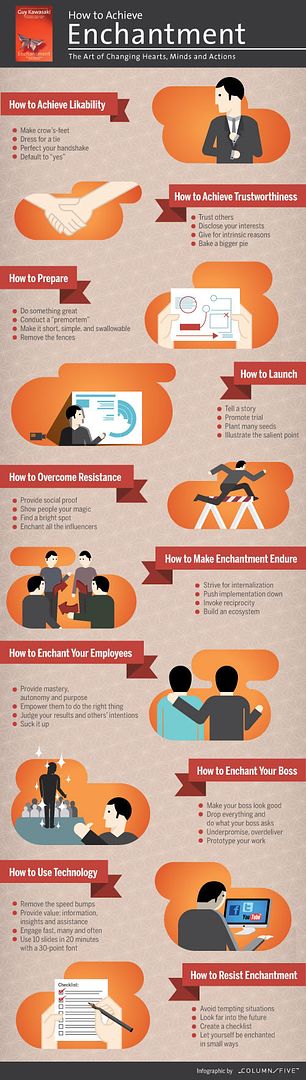
In promoting this book, Guy has provided a plethora of online resources. One of the more enchanting ones is a summary of how Enchantment can be achieved.

Enchantment Infographic, image hosting by Photobucket

Yes, it’s an Enchantment cheat sheet. But as we know, cheat sheets are only useful if you’re familiar with the material they represent. In other words, you get most out of it only if you’ve read the book. Specifically, this cheat sheet does two things:

  • it saves Walski from writing more than he needs to
  • makes you want to learn more (hopefully)

While Enchantment is very possible (and not difficult) to achieve, it may not be appropriate for everyone, or every situation. Guy is honest enough to provide examples of such personalities and situations in his book. As a bonus, he’s even provided an online Enchantment self-assessment you can try out to see how well prepared you already are to begin your journey towards being enchanting.

Walski’s verdict? If you are someone who needs to prepare his/her-self well in order that s/he can more easily and convincingly create buy-in (of some variety), then definitely go buy the book, once it’s available. In the US, the book should be on the shelves tomorrow (March 8, 2011), and probably in a few weeks time elsewhere.

And if you’re not someone who needs to create buy-in at this juncture of space-time, get it anyway. Purchasing a book, particularly a good one like Enchantment, is never a waste. After all, life is but a journey, and you never really know where it will take you, until you get there.

You never know – there may yet be a time when Enchantment is exactly what you’ll need. And a head-start never hurts.

Click here for the full post......

Tuesday, August 17, 2010

The depths of our descent

Technorati tags: , , ,

Still seething from the expected, but nastier than usual, tirade from Ridhuan Tee Abdullah (via The Malaysian Insider) over the weekend, Malaysia was rocked by this bit of unpleasant news yesterday.

Screenshot from The Star, image hosting by Photobucket

As if it weren’t enough that we have to now contend with a weekly dose, almost, of Ketuanan Melayu Celup, we get this wake-up call to tell us that racism is not only confined to the realm of political rhetoric, but exists for real in our everyday lives as well.

And when something like this happens in our schools, Walski shudders to think: just what has become of Malaysia that we’ve descended to such depths of uncivility?
(what The Star didn’t show, what the principal said, and more, in the full post)

The report from The Star hinted that what was uttered by the school principal was shocking and hurtful. What the report didn’t show (at least, not the online version), was what the principal actually said.

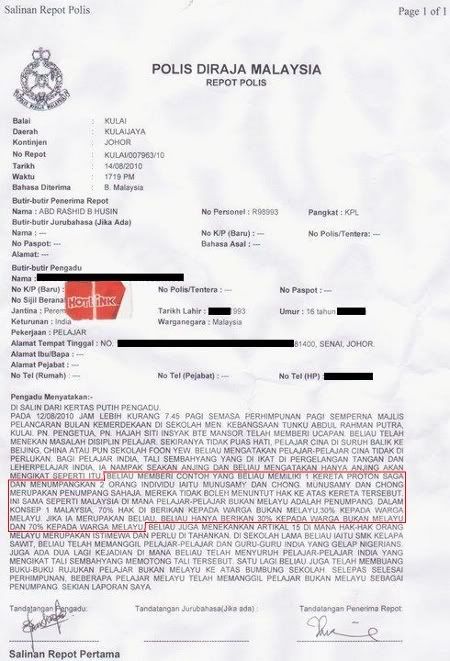
Malaysia-Today picked up the same news item and published it yesterday. In addition, it included a copy of an actual police report filed against the school principal by one of the school’s students. Walski has taken the liberty of posting it below, and highlighting a portion of the report.

Image taken from Malaysia-Today, hosting by PhotobucketImage taken from Malaysia-Today

The red-boxed portion of the image above (added to the original image by myAslum) is an excerpt of what the student filed in the report, and is something Walski has duplicated below - minus the ALL-CAPS - along with an English translation.

Beliau memberi contoh yang beliau memiliki 1 kereta Proton Saga dan menumpangkan 2 orang individu iaitu Munusamy dan Chong. Munusamy dan Chong merupakan penumpang sahaja. Mereka tidak boleh menuntut hak ke atas kereta tersebut. Ini sama seperti Malaysia di mana pelajar-pelajar bukan Melayu adalah penumpang dalam konsep 1Malaysia. 70% hak diberikan kepada warga bukan Melayu, 30% kepada warga Melayu. Jika ia merupakan beliau, beliau hanya berikan 30% kepada warga bukan Melayu dan 70% kepada warga Melayu.

She gave an example where she owns a Proton Saga automobile, and has 2 passengers, Munusamy and Chong. Munusamy and Chong are merely passengers. They have no right over the car. This is similar to Malaysia, where non-Malay students are passengers within the 1Malaysia concept. 70% of rights are given to the non-Malays, 30% to the Malays. If it were her, she would only give 30% to the non-Malays and 70% to the Malays.
(source: Student's police report, as posted by Malaysia-Today)

Almost sounds like something straight out of the Biro Tata Negara (BTN) playbook, if one didn’t know any better. And why this fixation of 30% by the school principal, named as Hajjah Siti Insyak Bte Mansor? Where did she get the idea that in the 1Malaysia concept, non-Malays get 70% of rights, compared to 30% of rights given to the Malays?

Aren’t all Malaysians equal citizens, regardless of ethnicity or creed? What gives?

Frankly, Walski is not really shocked that this kind of bigotry exists in Malaysia. He sees it online day in, day out. What he does find shocking is that people like this are allowed to be school principals. Heck, she doesn’t even have the right to teach, much less head a school. Incidences like this lends credence to the accusation that bigotry in Malaysia is institutionalized.

Granted, Walski acknowledges the fact that this kind of behavior is not condoned by the Education Ministry. But the ministry should do no less than to sack this person. The usual MoE modus operandi of transferring her to another school is only transferring the problem.

But what is the root-cause of such despicable behavior? And sadder still, this school principal has performed the Haj, an important obligation required of a Muslim to perform in his or her lifetime. Is this an example of religion being worn on one’s sleeve, while the soul and conscience remain as rotten as ever? Going by the date stated in the report, what Hajjah Siti Insyak said was on the second day of Ramadhan. Did she really think that her blatant display of bigotry would please God? Seriously, Walski has known many atheists who behave better than this, and have kinder dispositions toward other people.

Perhaps what happened is a symptom of the incessantly belligerent loud screams from organizations like Perkasa, whom we seem to be hearing from on a daily basis, and reported with such gusto and pride by the Malay-language mainstream press, as if Perkasa’s antics and demands are the best thing since roti banjir.

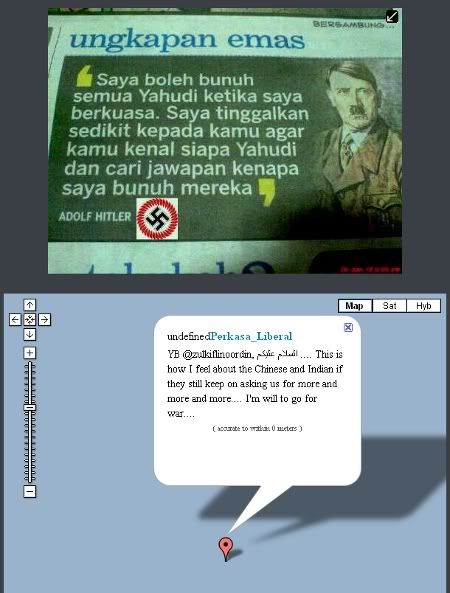
And when online personalities, who openly support organizations like Perkasa, make bigoted statements and threats of violence, Walski cannot help but be concerned. Take, for example, this idiot who goes by the handle Perkasa_Liberal.

Screenshot from UberTwitter, image hosting by PhotobucketIs this the kind of thinking Perkasa promotes?

Not very endearing to your fellow humans, if you were to ask Walski. The tweet above was apparently a reply to former PKR MP Zulkifli Noordin. If the image above is a bit of an eye-test, what the tweet says is this:

YB @zulkiflinoordin, السلام عليكم .... This is how I feel about the Chinese and Indian if they still keep on asking us for more and more and more.... I'm will to go for war....

And this is not just a one-off-kilter tweet from Perkasa_Liberal. His/Her tweets are almost all like that, over-flowing with sheer loathing and hate. Walski dreads to wonder what kind of person this is in real life.

It really stretches the imagination to figure out how someone can have so much vitriol in one’s heart, and be so consumed by bigotry. Is this the kind of ideologically bankrupt individual Perkasa has successfully created?

Because if you live and breathe whatever Ibrahim Ali and Perkasa have to say, and think it the gospel truth, you would probably end up thinking that life is indeed hopeless, and it’s all the fault of the ubiquitous “others”, whom you believe own more than 70% of everything you see. Including, in would seem, your own self-esteem.

Going back to our school principal earlier, how many more of such bigotry-infested individuals are there in our school system? More importantly, why are they allowed to be there in the first place?

Something very interesting, though, is how the school principal understands the 1Malaysia concept. It would really be a useful exercise to find out how such a warped understanding could be arrived at. Again, it is as if her entire world-view has been shaped by the rhetoric of Perkasa and UMNO, and reinforced by what BTN has purportedly been saying during their courses.

But if it is the root-cause that we’re after, perhaps the real answer lies in what writer Kee Thuan Chye wrote towards the end of his response to Ridhuan Tee’s piece, published earlier today at Free Malaysia Today.

"Really, it is this fixation on the issue of race that has brought our country into a fine mess."

Walski couldn’t agree more – especially about the “fine mess” part. We have somehow developed this tendency to view and measure just about everything from the race angle.

It may be that from the physical point of view, Malaysia has come a very long way from where we were 53 years ago. 48 years ago, even, when Malaysia proper came into being. But beneath the shiny veneer of physical development, we seem to be drifting further apart as a people, with each passing day.

The Hajjah Siti Insyaks and Perkasa_Liberals around us are clear signs of this. But more than that, they are obvious indications of just how deep we’ve gone in our descent from greatness.

How much deeper and further do we have to go before we say enough is enough?

Click here for the full post......

Thursday, December 17, 2009

Burgeoning Tartar Nationalism

Technorati tags: , , , ,

Tartar of the dental kind, image taken from Colgate's UK website, hosting by Photobucket Biro Tata Negara, BTN, or the National Civics Bureau (so-called), has been hogging the news limelight of late. Although the BTN has been a sore thorn in the side of civil society for a long time, the story really flared up big time sometime in November this year, as a result of the Selangor state government wanting to bar its civil servants from attending “nation-building” courses organized by the bureau.

Like many others, Walski has his own BTN story to tell. He won’t relate it here in its entirety, but suffice it to say, the phrase “mata sepet” (slant-eyes) was used to refer to a certain community in Malaysia that’s not Malay. Needless to say, not in a very nice way.

As in, “Ada tak nampak sapa-sapa yang mata sepet dalam bilik ini?” (‘Do you see any slant-eyed people in this room?’). Back then, there wasn’t much politicking against ‘opposition’ parties, or Malay Supremacy tendencies, only the constant reminder of how Malays must be thankful to the government for scholarships, preferential treatment and other sorts of assistance given.

But racist tendencies? As Sarah Palin would say, “You betcha!”

Search around the Internet, though, and you’re bound to find numerous anecdotal accounts of similar (if not worse) overtures. Similarly aplenty are those in support of the BTN programs, particularly pro-BN types. Ministers, even.

The debate on- and offline got so heated that the PM himself stepped in to attempt to put a stop to the brouhaha, saying that he alone will decide the fate of BTN. As a follow up, though, he’s asked that more 1Malaysia content be put into the BTN syllabus (both links via The Malaysian Insider).

Well, it better have – somehow, 1Malaysia and institutionalized racism are two concepts that shouldn’t even appear in the same sentence. Okay, they both just did – which is a good indication that the BTN programs in their current form probably need some tweaking.

Make that a general top-down overhaul.
(BTN sycophantasies, racism, and more, in the full post)

But apparently not everyone agrees that BTN is problematic. Take, for example, Deputy Minister in the Prime Minister’s Department, Datuk Ahmad Maslan. He, hands down, gave the most sycophantic defense for the bureau – according to him, BTN is the reason why Malaysia has survived for the past 35 years.

The Biro Tatanegara (BTN) course has helped to maintain peace among people of various races and religions for 35 years, Deputy Minister in the Prime Minister’s Department, Datuk Ahmad Maslan (left) said today.

He said Malaysia would have been destroyed long ago if the BTN course was racist as claimed by the opposition.

“Millions of people had attended the BTN course since 1974. Malaysia would have been destroyed if not for the BTN course. It made the nation good and successful.

“The BTN course modules apply to all groups and aimed at nurturing pure values and the spirit of unity,” he said after presenting a paper titled “Gagasan 1 Malaysia” at the 1 Malaysia Seminar for the Prime Minister’s Department (JPM) staff here.

He said BTN not only organise courses but also other programmes to nurture the spirit of patriotism.

“Those who say that BTN course is racist are afraid of their own shadows,” he added.

(source: The Malaysian Insider)

Now, the BN-led government’s idea of patriotism is probably a tad bit different from how the rest of the normal world understands the meaning of the word to be. BN views patriotism as love not just for the country, but also for the government of the day (BN-led, of course), and the required un-love of any party opposed to it.

Perhaps the best come-back was made by blogger Aisehman, who had this to say, with regards to the bit about the “being afraid of their shadows” in the by Datuk Ahmad Maslan news report.

Well, people who espouse ethnic superiority cast none, the bleeding vampires that they are.

Get it? Or is that too sophisticated for you to wrap your Ketuanan Melayu head around?

(source: Aisehman's blog)

All this while, Walski thought that vampires cast no reflection. Like in mirrors. Oh well, it still was a barrel of laughs and a classic Aisehman kind of comeback.

But perhaps it is time that we looked beyond merely pointing fingers at BTN’s faults, granted there are many. It’s probably better to focus on how we can put the “Civics” back into the bureau’s moniker. And not the Honda kind, either – those are more than abundant on Malaysan roads as it is.

And forward-looking is exactly what blogger/lawyer/all-around-wonderful-human-being Art Harun focused on in relating his very own BTN Experience.

I think many parties have missed the point. This is not about assigning guilt. It really does not matter what DSAI, DrM or anyone had said or done. It is about our future. It is about our kids. Because the BTN targets our kids.

It is about finding out whether something wrong has been done. If so what are they and what are the solutions? Are we going to continue with the wrongs, if indeed there are wrongs. Or are we going to revamp it?

It is about correcting the wrongs, if any, and improving the things which are right.

(source: Art Harun's ARTiculations)

No one doubts – or at least, Walski doesn’t – that BTN was set up with the best of civic intentions. But like many Malaysian government agencies, politics get in the way, and over time, BTN has evolved into somewhat of a brainwashing organization. Which is not to say that it’s totally bereft of any redeeming qualities. It’s just that there’s probably more bad than good.

As the target of the BTN programs is our impressionable young ‘uns, it’s important that partisan politics doesn’t come into the picture. And neither should racism. Playing one race against another somehow doesn’t quite contribute to nation-building in Walski’s book.

Because racism, in a way, is like tartar that can accumulate on your teeth. Once the stuff sets in, the only way to get rid of tartar is by means of professionally executed scaling, by a qualified dentist. And if you’ve ever had your teeth (and the area below the gum line)scaled, you’ll realize that it’s akin to a minor surgical procedure.

But unlike tartar, no surgery in the world can remove racism once it sets in.

Reblog this post [with Zemanta]

Click here for the full post......

Friday, March 13, 2009

I Я Language Supremacy

Technorati tags: , , , , ,

Image taken from ephc.com, hosting by PhotobucketIn talking about certain issues currently facing the nation, the term stakeholder is often mentioned. The term refers to a person, or group of persons, with a vested interest in a particular issue or problem.

In vampire movies, on the other hand, stakeholder could also refer to the guy (or gal, but usually not) trying to drive a stake through the heart of the undead blood-sucking vampire. This happens in the more campy Dracula-type films. Or even in uber-cool vampire flicks, like From Dusk Till Dawn, for instance.

On very rare occasions, like on a Friday the 13th like today, on a silly blog like myAsylum, both definitions of the word sometimes collide. Especially when zombies are thrown into the mix. Which brings us to the definition of  stakeholder that this post will use: "blood-sucking zombies trying to drive a stake through the heart of Malaysian education".

Image hosting by PhotobucketHow many Malaysians does it take to hand over a memorandum?
(picture taken from Perisik Rakyat®)

Unlike the zombies we're used to (and probably prefer), however, the ones Walski has in mind are very much NOT undead (which actually makes them MORE dangerous). It's just that they're prone to not seeing the bigger picture, and are very susceptible to that popular Malaysian infliction - gullibility.
(what the kids have to say, brownie points, and more, in the full post)

Personally, Walski thinks that the instruction of Math and Science should remain in English. So far, from what he can tell, nobody seems to have bothered to ask the school kids (the real stakeholders) what they think about it. Or, at the very least, the rhetoric about why the medium of instruction should revert back to Bahasa Malaysia/vernacular languages, rarely takes the students opinions into account.

Which is why is looks like yet another issue that has been hijacked and made into a political agenda by language supremacists, almost unilaterally. Politicians from across the divide have also pitched in to make this into more of a political issue, rather than an education-related one.

So, what do the kids think? Here's the opinion of one Adam Azhar, a 9-year old, about learning Math and Science in English (hat-tip: Rocky's Bru, emphasis by myAsylum).

I heard my mum and daddy were talking about people that do not like the idea of learning math and science in English. But i think it's pretty cool. It makes me always want to do more revisions. If i don't understand anything or terms that the teacher used at school, i go back and search it in the dictionary or ask my parent. Sometimes i even use the internet.
(source: This Is My World)

And sometimes he blogs - quite well, Walski thinks. Azhar's got pretty cool parents, too. Why? Because they're bringing up the kid with good values - like having a high regard for hard work, that it's okay to make mistakes (but learn from them), and that there's no short-cut to success.

Contrast this to the "membebankan guru dan murid" (burdening the teachers and students) arguments. Like everything in life must be easy-peasy. Granted, the implementation of the program hasn't been well executed, but Walski thinks the program itself is probably one of the few (if not only) intelligent things that the Ministry of Education has done to the curriculum in the last decade.

In covering the PPSMI debate, Malaysiakini did an interview with some school kids, and asked them what they thought. The responses were mixed, as is expected. But what's interesting is who said what. The demographic mix, in other words.

Some interesting observations that Walski picked up from watching the 9-some minute video:

  • the emphasis on racial difference seems to be inculcated in school. Those who are weak in English are those who don't mix with others not from their own ethnicity
  • the only ones who seem to prefer a reversion back to BM come from a very specific demographic group (hint: not just ethnicity, but gender as well)
  • switching from one language medium to another, earlier on, wasn't easy. But most managed. Switching back isn't a brilliant idea, either (and this comes from a Form 3 student!)
  • most students interviewed showed a strong desire for self-improvement. Those who didn't belonged to a very specific demographic. The "we love our tempurung" group. Walski wonders why.

The Ministry, of course, has been dragging its heels in making a decision whether to maintain the Math and Science medium of instruction in English, or not. One likely reason is the upcoming UMNO party elections - politics, again. It's a shame that our politicians care more for their political careers, rather than doing the right thing. And not only the UMNO ones, either. Politicians from PKR and PAS are equally guilty of turning the whole PPSMI thing into a political debate.

Well, now you know what Walski thinks, and you have a feel for what some of the students themselves think. What's your opinion?

If you've noticed, the new poll that Walski's put up (the one he mentioned yesterday) is related to this very topic. So, what do you think about PPSMI, the protests against it, and what not. Take the poll, and maybe leave a comment (or three) as well. If you own a Blogger blog, you can put up the survey on your blog, too, simply by clicking on the icon below it.

It's no big secret that the Ministry of Education portfolio is a must do for any PM aspirant in this country. It is, among other things, a political stepping stone. And every minister who's ever held that portfolio has made sure that he's (never been a she) left his own legacy behind. Some of them good legacies, but many of them damaging, as well. This, in part, is why our so-called education system is in a total mess today. It's always been about political mileage, to varying degrees, and not education for its own sake.

Walski thinks that when it comes to PPSMI, it's the implementation, not the program itself, that needs some focus and revisit. The thought that energy is being expended to look at the feasibility of reverting back to BM clearly shows that it's more about scoring political brownie points, rather than focusing on the real problems. Yes, a review is needed, but the right kind of review.

Look, mastering a language - any language - is an asset. And for one to master a language, one needs to use that language, not just learn it as a subject. PPMSI forces students to apply the English language, something that merely learning the language as a subject has somewhat failed in providing students with an acceptable level of proficiency.

It's high time for the Ministry of Education to show some backbone and balls, and not pander to the I Я Language Supremacy zombies. Brownie points today, another wasted generation 10 years down the road.

For once, do the right damned thing... and right is not always popular.

Walski's bad English post title clarification footnote: The title of today's post was inspired in part by the cartoon series, I Am Weasel, which used to be shown quite a lot on the Cartoon Network on Astro (yes, Walski watches the Cartoon Network).

Image hosting by Photobucket The more interesting character in that series is I.R. Baboon, whose silly characteristics include lousy grammar, and, how he writes the letter 'Я' (like how you see it). To Walski, Baboon is, by far, the more interesting regular character in the cartoon series - pants-less, red-buttocked, nose-digging buffon of a baboon. And in a twisted kind of way, it's Baboon, not Weasel, that's the true hero.

Walski just loving it!

Click here for the full post......

Sunday, September 07, 2008

51 Ideas for a better Malaysia

Technorati tags: , ,

Walski's more-than-51-word descriptive forenote: Remember Walski's contribution to Nizam Bashir's brilliant blog project last year, 50 Posts To Independence? The time has come for another contribution to another brilliant initiative of Nizam's: 51 Ideas for a better Malaysia. See the first of the 51 ideas here to get an idea of what this is all about. What you will read in this post is idea #2.

Background to Idea #2
Image hosting by PhotobucketMalaysia just celebrated its 51st Independence Day exactly one week ago. But 2008 has been an unprecedented year for a few reasons. As we witnessed on March 8th, 50 years of BN (and Alliance, prior to the 70's) 2/3 majority representation in Parliament was broken. But of more concern is that we've seen the race card being played by certain quarters more fervently, unlike any other time in recent memory. We've also seen more and more reports against Biro Tata Negara (BTN) surface, accusing it of being blatantly and unabashedly racist in its programs - nothing new, really, Walski witnessed this first hand back in the 80's, and he reckons it's only gotten worse since then. 

In 2008, it would seem, we're becoming less of one nation, and more of race-compartmentalized communities unwillingly stuck together by a flimsy adhesive called citizenship. And even that is being questioned by some. It's no big secret who the some are. But that's beside the point of this post, so it's really not necessary to mention who. 

This is the impression Walski gets, anyhow, going by the political rhetoric in the press, mainstream or not, online or off. And that impression, before it becomes stark reality, has to be put to a stop. But it's not an easy process, and therefore the idea is not of the short-term quickie fix variety.

The Idea: Overhaul the entire Malaysian Education System 
Not just the ad hoc fixer-upper changes, like the ones over the years that have themselves contributed to the decline of the system, but a complete, unemotional, rational, potentially politically unpopular and painful overhaul. Strip the entire system apart, remove the gunk that's built up over the years, re-tool and replace the parts that are damaged, then finally put the system back together, from scratch.

And in rebuilding, the following 3 foundational concepts must be kept in mind:

  • Instilling the love for Pursuit of Knowledge
  • Solidarity as One Nation
  • Mutal respect regardless of creed or color

(foundations slightly expounded, and more, in the full post)

Instilling the love for Pursuit of Knowledge
Pursuit of knowledge is more than just learning facts for examinations. What Walski proposes goes beyond the system of rote learning - it will be more experiential in nature, and while it should teach our kids something befitting of their age at the time (incorporating Idea #1, by Nizam Bashir, of course), it should also instill the love of learning for its own sake. The pursuit of knowledge is a life-long journey, and it should not end with paper qualifications in hand, something we see more often than not.

For this to happen, however, what's also needed are a qualtiy teaching force. Not merely the civil-service minded teacher who goes into the profession because there is no other viable choice (may not be true today, but certainly was the case when Walski finished his education some 20+ years ago). Teachers need to also be individuals with a thirst for knowledge and a love for teaching. We need teachers who teach because teaching is their passion, and not because they have to.

From an aptitude point of view, because no two students are wired the same, the current strictly age-based system needs to go. But the minimum age should be set at 5 years-old - Walski's not proposing to rob children of their early childhood - and admission of those 6 and below should be based on a simple learning aptitude test.

Another thing is that learning needs of a child should also be taken into account by the curriculum - some have accelerated learning abilities, and some diminished. Having a lowest-common-denominator system only produces a lowest-common-denominator product. The curriculum needs that sort of flexibility.

Solidarity as One Nation
And this perhaps is the most important attribute of the revamped system. 

Walski is of the opinion that racial polarization starts in school at a very early age. The fact that we have a national+vernacular+religious parallel system means that polarization begins with the decision of what or which school to send our kids to. Walski thinks that there should be one, and only one type of school - the Malaysian National School.

The characteristic of this school? Firstly, the medium of instruction will be in English. Now, before you start screaming Language Imperialism at Walski, hear him out. English, in as far as Malaysia is concerned, is a neutral language, apart from being a worldwide language. English is a language that does not potentially give one racial group or religion exclusive claim, unlike Bahasa Malaysia, Mandarin, Tamil or Arabic. Yes, Bahasa Malaysia is the National Language, and so it should remain, and therefore should be made compulsory to learn in the proposed revamped school system.

So here's the deal - language of instruction shall be English, with Bahasa Malaysia a compulsory subject for all, and in addition, a third language shall also be compulsory (the third language can be any useful language, by the way). Command of language should be viewed from a skills point of view, and should not be politicized or stigmatized. The more languages a person has command of, the wider his or her scope of opportunities becomes. It is that simple.

Then, a common Civics education for ALL should be reintroduced. One big source of polarization in schools today, in Walski's opinion, is the separation of Muslims from the Nons. Too many times Walski has been told of how Muslim kids are taught from early on to distrust persons of other religions, through the process of Ugama class. Sure, it's not part of the "official" curriculum to instill hatred and distrust for others, but happen it does indeed. More often than not this distrust, based on religion, is naturally extended to race as well. This has definitely got to stop. It won't be a politically popular thing to do, but it must be done, lest we want generation upon generation of indivuals to come inheriting this dark side of the Malaysian education system. Sure, there have been a minority who are the product of the current system who do not have the sense of deep distrust and innate hatred, but Walski thinks it is too small a minority.

Any other religious or spiritual needs, over and above a universal civics curriculum, should be catered for by the respective parents and guardians of our school kids, and not have that responsibility relinquished to the state, and definitely not to our national school system. It is only then can we cease to have instances of parents complaining that their kids are being imposed with religious or spiritual beliefs contrary to their own belief system. 

The role of parenting should remain with parents. The school system has many purposes. Acting as surrogate or replacement parents is NOT one of them.

Most importantly, the schoool curriculum must instill the notion that we are all equal citizens of this nation, and therefore equal stakeholders of our nation's future. Then, and only then can solidarity, as a nation, truly be achieved.

Mutual Respect regardless of Creed and Color
Related to the second attribute is the third - that we are all human beings, and that we all bleed the same color red. The root of all evils that exist in our society today, as Walski sees it, is the absence for respect, both for self and for others.

Respect is a funny thing - the more you demand of it, the less of it you get. Instead, the more you give, the more of it you receive in return. Walski has no clue why, but that's how it happens to work.

When we put barriers of exclusivity around ourselves, based on a perceived belief that we are somehow "special", and then demand that our "specialness" be respected, you cannot rationally expect others to suddenly kow-tow to your demands, just because of your say-so. Especially when there are no signs of sincere reciprocity.

Summary
The idea of revamping the entire school system proposed here is in no way comprehensive - it's impossible to lay out all the details in one single blog post. It does, however, lay a broad basis for us to move forward. But for any revamp to succeed in its objective, a strong will is required - a willingness to look beyond political popularity or narrow communal interests. This willingness must be strong enough to resist any steering away from objectives, simply for the sake of expediency and political correctness.

The framework Walski proposes here is definitely not going to be a popular one, but one that Walski feels is for the betterment of our nation as a whole. It is an education system based on the principle of nationhood and solidarity, and one that tries very hard to move away from a worldview seen through the tint of race/religion division - something that Malaysia, after 51 years of independence, seems to have found itself mired in.

~ ~ ~ o O o ~ ~ ~

Many thanks to Nizam Bashir for selecting Walski as the second poster for this excellent blog effort. Rather than rely on the usual suspects, the next idea, due in 7 days (on September 14, 2008), will come from someone whose writing Walski holds in high regard. It comes from someone much younger than Walski, and stands as a living example of why Walski is a firm believer that youth is not always wasted on the young, and at the same time gives Walski hope for a better Malaysia in the future. This person is none other than Michelle Yoon, the bright young writer behind I Am Malaysian. 

Click here for the full post......

Wednesday, May 14, 2008

Lazy Myth of the Native

Technorati tags: , , , , ,

This post has actually been brewing for almost a couple of weeks. And just like a good batch of tapai (a local quasi-alcoholic fermented dessert) in wait for that just-right type of brewer's yeast, the post was waiting for a catalyst.

And yesterday, Walski found just that catalyst he'd been waiting for, courtesy of The Star.

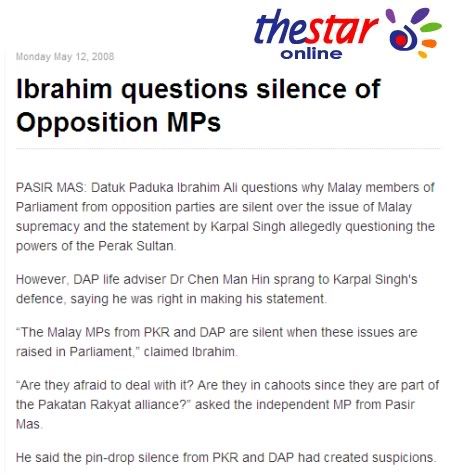
Image hosting by PhotobucketIbrahim Ali: Malaysia's version of David Duke

To answer the rhetorical question posed in the first paragraph of the news report: why Malay members of Parliament from opposition parties are silent over the issue of Malay supremacy and the statement by Karpal Singh allegedly questioning the powers of the Perak Sultan?

Could it be because they're not race-supremacist dickwads like you?

For the time being, we'll leave Ibrahim Ali for a bit, and let him simmer in his grandiose ketuanan delusion. A delusion, that after all, is built upon many myths.

Let us now rewind to Sunday, May 4th... at the closing of the Kongres Permuafakatan Melayu (or Malay Covenant Congress, loosely translated), held in Johor Bharu, where a resolution was drafted. This congress has apparently been touted as something rather landmark for these folks, giving birth to a resolution, as a guiding document for the furtherance of the future struggles and aspirations of the participating pro-Malay groups.

Reading through the resolution, Walski finds some of what's contained in it to be pretty ironic. Because if taken to the letter, what these folks have resolved to do is to stagnate the Malays to the point of sociological extinction.
(native irony of the lazy myth, and more, in the full post)

But before we delve deeper into what's contained in the resolution, perhaps you are wondering what's this Lazy Myth thingy Walski keeps talking about. Simple - a Lazy Myth is one that's based on sketchy facts no one bothered to research properly. Meaning that the propagators of these kinds of myths were just too damned lazy to research it thoroughly. And took it on some authoritative person's authority to be true.

Okay, now that we've gotten that mythical definition out of the way, let's take a look at what the resolution actually says. Incidentally, the version of the resolution Walski found (since he doesn't buy the print version of Utusan/Migguan Malaysia) is what he believes to be the almost-final draft version (via Qaiyum.net). The full translation of this resolution into English can be found at Walski's other blog, myAsylum reLoaded.

The resolution covers seven areas:

  1. Constitution (Perlembagaan)
  2. Politics (Politik - since there is no native Malay equivalent)
  3. Economy (Ekonomi - for the same reason)
  4. Islam
  5. Malay Language (Bahasa Melayu)
  6. Education (Pendidikan)
  7. Culture (Budaya)

Under the Constitution heading, we find the usual to-be-expected protection of the special rights and position of the Malays, etc. The first irony, however, comes in via the third point, which says this:

Menentang segala tafsiran sewenang-wenangnya yang bersifat memilih terhadap fasal-fasal Perlembagaan bagi tujuan kepentingan dan perkauman.

Oppose all arbitrary interpretations of any constitutional articles, selectively done for the sake of self-importance and racism.

But Walski supposes that if it has to do with the self-importance of the Malay race, then it's okay. Ironic? Try hypocritical. But okay... these Malay ultras probably want Malaysia to remain race-based, with the Malays being dominant. At any cost. Even if it means making contradictory demands within the same resolution.

Under the heading of Politics, for instance, it's rather clear that the last thing these Malay NGOs want is for equality. Especially when you have articles under this heading that calls for things like:

Oppose any human rights interpretations and democratic processes that set aside Malay soveriegnity, or

To fight for the role of Malay soveriegnity as the core and ideology of Malay political parties, and reject any foreign ideology pertaining to a Malaysian Malaysia

Opposing a Malaysian Malaysia? So what do they want - an Apartheid Malaysia? Where citizenship is contingent on race, and, in the Malaysian context, religion?

Later on in the resolution (under the Economy heading), however, these same folk want economic equality. Or, to be more specific, at least 65% equality. And for the first time, Walski comes across this cool term called Economic Jihad.

And now comes the really ironic part - rejection of multiculturalism, and rejection (and if possible, abolishment) of the use of English.

To understand why Walski finds this very ironic, though, let's ask ourselves this question: What is the Malay race?

The information Walski presents here, in part, comes from Farish Noor's lecture Walski attended a couple of weekends ago (which coincidentally was the same weekend the conference took place). The Constitutional definition is that to qualify as Malay, one must profess Islam, speak Malay, and practice Malay culture. In which case, prior to the 1400s the Malay race did not exist (since Islam only came to the region around about then).

But another myth is that there is this monolithic entity called Malay Culture. An entity that "always was" the way it is, if you were to believe these Malay ultras. As far as Walski understands it, there is no such thing. One simple observation - Malay weddings. Each state has it's own peculiar custom and nuance. For instance, the bridal road-block tradition, which one can observe in traditional Johor Malay weddings - you don't find this practice in other states, as far as Walski knows.

As Walski mentioned in his earlier post Alphabet Soup Saturday the reason for this lazy lumping of many cultures into one, neat category of Melayu, comes from the colonial census exercises, carried out between 1871 and 1931. And ironically, it is this same colonial compartmentalization that these Malay neo-cons prescribe to.

In fact, elements of what constitutes "Malay Culture" as we know it today comes from the inter-mixing of various cultures (Javanese, Bugis, Minangkabau, Peranakan Chinese, etc.) over the centuries. In other words, "Malay Culture" is today what it is through the evolutionary process of multiculturism!

By outright rejecting multiculturalism what these ultras (or neo-cons) are trying to do is to freeze culture from the natural process of social evolution, and thus stagnating it. And anything forced to stagnate is one day going to die off. The resolution, therefore, instead of advancing "Malay Culture", is in fact going to one day totally kill it off.

And then we come to the vehement hatred for English. While the rest of the non-English speaking world is clamoring to learn and master the language, these ultras want to eradicate its use in Malaysia, if they have their way. Walski can think of only one word to summarize what he thinks about that idea - STUPID.

In fact, there's no better way to get totally left behind the rest of the world, in Walski's opinion. Herein lies the other irony.

So, at long last, back to Ibrahim Ali. Now, this guy's stance on Malay supremacy (or as in the resolution's language, soveriegnity - same difference) is very well-known. Now, Walski doesn't know whether or not Ibrahim Ali supports the resolution, (or was even present at the conference) as his UMNO cohorts Muhyuddin Yasin and Muhammad2 Taib have (see footnote for article references).

The bottom line is this continued emphasis on race. The Malay Race - as if we're talking about an entire unique species. To move forward as a nation, in Walski's opinion, we have to accept the reality that this nation is multicultural, has a rich history of multiculturalism (like it or not), and not get mired in the rhetorics of race, which serves one, and only one purpose - UMNO.

Racial compartmentalization is what our colonial masters utilized to rule over this nation. And yet, it is exactly the same racial compartmentalization and promotion of one race's ideals (and only that race), presented in this resolution, that is being touted as landmark.

Walski ends this post with something from a book that he just finished reading. In fact, it comes somewhere towards the very end of this important book (emphasis by myAsylum).

Does your society have more memories than dreams, or more dreams than memories?

By dreams I mean the positive, life-affirming variety. The business organization consultant Michael Hammer once remarked, "One thing that tells me a company is in trouble is when they tell me how good they were in the past. Same with countries. You don't want to forget your identity. I am glad you were great in the fourteenth century, but that was then and this is now. When memories exceed dreams, the end is near. The hallmark of a truly successul organization is the willingness to abandon what made it successful and start fresh."

In societies that have more memories than dreams, too many people are spending too many days looking backward. They see dignity, affirmation, and self-worth, not by mining the present but by chewing on the past. And even that is usually not a real past but an imagined and adorned past. Indeed, such societies focus all their imagination on making that imagined past even more beautiful than it ever was, and then they cling to it like a rosary or a strand of worry beads, rather than imagining a better future and acting on that. It is dangerous enough when other countries go down that route; it would be disasterous for America to lose its bearings and move in that direction.

{Source: Thomas L. Friedman - The World is Flat [2006 Revised Edition] (p. 553)}

Replace America with Malaysia, and you can immediately see why Walski fears for the future of this nation, if any of these resolutions are put into motion, particularly those that aim to isolate and stagnate this nation. Ibrahim Ali and many of his cohorts in UMNO fall into the category of glorifying a mythical past, and wanting to bring us back to that imagined glory, in Walski's opinion.

But if you fall into the same mindset as these neo-cons, by all means, hold on to these Lazy Myths and to the idiotic resolutions that these upholders of the Lazy Myths have churned out. Just don't force the rest of us Malaysians, who want to move forward, to ride in that sinking ship with you.

Walski's supportive neo-con politician's article listing footnote: Several UMNO politicians have decided to commit political suicide (in Walski's book) by supporting the resolution. Here is a collection of articles, printed from Utusan, covering the event and eliciting support from these prominent politicians. They're all in Bahasa Malaysia, and unfortunately, Walski doesn't have the time, energy nor desire to translate them. But one thing is apparent - the feudalism is strong in them folks...

Speaking of required reading, there are two books that Walski feels are required reading for all Malaysians. One examines the past, while one prepares us for the future. The first is "The Myth of The Lazy Native" by Syed Hussein Alatas, which gives us a glimpse into the past, enabling us to understand the present. Unfortunately, it's out of print, but if you look real hard, you may find a PDF copy somewhere on the net (hint: Walski found it). The second must-read book is "The World is Flat: A Brief History of the 21st Century" by Thomas L. Friedman. This book helped Walski realize that, in the bigger scheme of globalization and the real world, all this petty race-relatied bullshit we're mired in here at home don't amount to a hill of beans. But more importantly, it tells us what needs to happen for us to survive a fast-flattening world...

Click here for the full post......

Saturday, March 17, 2007

Educational benefits of porn

Technorati tags: , , , ,

Related post: How did you learn about SEX?

UPDATE: Marina M. has been so kind as to provide some relevant (and important) perspective about what's actually happening as far as the Malaysian school curriculum is concerned (see the comments section). Thanks Marina!

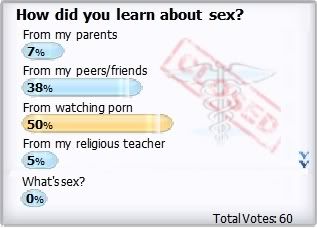
Porn - that's how 50% of those responding to this past week's survey say they learned about sex.

Image from dpolls.com, hosting by PhotobucketFortunately, all 60 respondents know what sex is

Not at all shocking, to tell you the truth. It's probably something we already know, but didn't want to admit. Another thing we probably don't want to admit is that the absence of proper Sex Education in schools may be a contributing factor to why kids venture to experiment with sex earlier than they should. And worse, unprepared.

The next largest group, 38% (or 23 votes) claim they learned about sex from their friends. And since at least half of them probably learned from porn, we can estimate that the actual number who learned about sex from porn (directly or indirectly) is around 69% or so. Okay, this is a bit of an extrapolated stretch, but again, not that difficult to believe.

Of course, this survey is far from scientific, but it does give us an indication of the fact that a lot of us probably are not getting accurate information about sex. This includes the risks (of infection) as well as the liabilities (particularly pregnancy).

By the way, Sex Education is a lot more than teaching kids to fuck, as many ultra-moralists would like us to believe.
(more sexy educational thoughts, in the full post)

It covers human development (from conception to birth), contraceptive methods, emotional and physical changes during the adolescent years, risky sexual behaviors, sexually transmitted diseases, dangers of sexual and child abuse, and a number of other associated areas - and yes, many curriculums worldwide include details of sex itself (source: Wikipedia).

Here in Malaysia, formal Sex Education has not yet been introduced in schools, although it has been discussed for a number of years now. Walski's guess is that there is strong resistance from the influential moralistas out there, be it in Government, the BN, as well as within the Opposition parties (particularly the PAS-types, one would imagine).

Everywhere in the world, when the subject of sex education is brought up, a moralistic position won't be far behind. The general popular argument is that introducing sex education will cause immorality among youth. Another associated argument is that instead, more religion should be thrown at the kids - in other words, Abstinence Education. Yeah, that works great with raging hormones.

But let's put the pros and cons of Sex Education aside for a moment, and look at the reality of today's society. Of late, there has been a noticeable increase in reported sex-related crimes - rape, incest, molestation. Rape aside, could the cases of incest and molestation of children possibly have been avoided if the young victims recognized early on that the perpetrators of such crimes were touching them physically in an inapropriate way?

The moralistas, when hearing about teens getting pregnant, or in extreme cases, giving birth at school (as happened recently in Perak), immediately point to moral decay, and actually have the gall to use these unfortunate incidents as proof of why Sex Education should not be introduced.

Or what about the pro-segregationists? That kids should be sexually segregated at as young an age as possible? You know, it wouldn't surprise Walski an iota, if one day, he woke up to read a news report of some nutcase suggesting that all young people, upon reaching puberty, be chemically neutered, temporarily, until they get married.

From Walski's straw-poll survey, 5% (or 3 votes) stated that they learned about sex from their religious teachers - hopefully, not the hard way. But has anyone of you actually read the marriage manuals written purely from the religious perspective? Specifically those written for the Malay/Muslim demographic? (Walski can't really comment about those written for other religions, 'cause he's never read them)

Well, Walski has. And if someone who had absolutely no idea what sex is prior to reading these "manuals" read 'em, it would be interesting to find out what their opinion about sex were after. First of, most of these books talk about the importance and function of marriage, from the "Islamic" perspective. Usually, only about one chapter is devoted to sex itself, talking about the wedding night.

It's been a long time since Walski picked one of these up, and if memory serves him correctly, the one book that Walski remembers was written circa 1970's.

What Walski remembers:
► that there are 1001 prayers (do'a) to recite before, during and after sex (okay, maybe not that many)
► the best night of the week to perform sexual union is Thursday night (eve of Friday)
► sex must be performed with as much clothing on as possible
► the only permissible position is the man-on-top (aka missionary) position
► oral sex is prohibited, as is acts of self-pleasure
► and where any of it even touches on pleasure, it's always the male's pleasure that is emphasized. Women, it seems, have one, and only one, role to play - that of being the bearer of progeny. Far be it to be proper for women to view the exercise as pleasurable

So, it would really be interesting if those who responded (the 3%) could come back and elaborate exactly what they learned from their religious teachers.

But the whole point is that except for the very few (7%, or 4 votes, per the survey) that learned about sex from their parents, it would be a safe guess to say that we learn about sex through channels that probably don't prepare us well enough to deal with the risks and consequences of sexual relations.

Where sex is even discussed, it's usually done in a morally high-handed way, typically leaning towards don't, don't and more don't, rather than discussing the pertinent issues that the young need to know (like safe sex, HIV and other STD risks, and of course, pregnancy). Some kids are gonna learn about fucking one way or another - it's a question of whether we're willing to prepare them for it or not. The general state of denial that we're in today is not helping them one bit. In fact, Walski dares say, to the contrary - we're putting them at risk.

So, until and unless Sex Education is introduced - properly, and covering everything it should - it would also appear that porn is probably going to remain the key educational resource for sex education. All this political pussyfooting, avoidance and delay tactics is not helping anyone a single bit.

And to the anti-Sex Ed moralistas that happen to read this, do us all a favor - the next time some unfortunate youth becomes the victim of sexual consequence, just hold the rhetoric, stop blaming "moral decay" and start blaming yourselves. At the very least, get out of denial mode, 'cause it's starting to sound pathetically tiresome...

Click here for the full post......

England not my mother tongue...

Technorati tags: , , , ,

Walski's NaSTy Pee embargo note: Yes, Walski seems to have broken the embargo, but not really. He still does not purchase any NST publications, although has relaxed the online viewing bit on occassion, when necessary. This is one of those necessary instances.

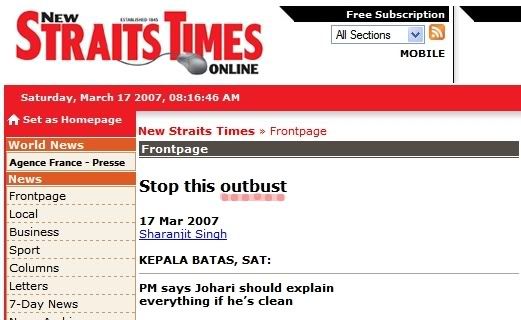
"England not my maar-der tongue" is one of those defensive outbusts outbursts Walski has gotten a few times in the past when trying to correct someone's England English. And apparently, it's also not the mother tongue of some Malaysian news editors either.

Image hosting by PhotobucketWalski wonders if this actually made to the print edition...

The word should probably be outburst, and not outbust. Which sounds like a competition to determine who has the larger bossom. Like in "Britney Spears outbusts Kate Moss". The news article, however, had nothing to do with Pak Lah admonishing anyone's breast-size competition. It had nothing to do whatsoever with breasts.

To be fair, though, outbust does exist - in the made-up words category. So, kudos to the NST for their creative England English. Ah, yes... English as she is broken.

Okay, enough of NaSTy-bashing for one morning... the point is that the standard of English in Malaysia leaves much to be desired. Walski does his part in trying to correct his colleagues' English when he can, or people around him - without being too obnoxious.

For example, (to address Lucia's query) pursue versus pursuit. One's a verb, and the other a noun. One can pursue A's in a public exam like SPM, but the act of doing so is called pursuit of A's. What Walski sees (with a certain small amount of chagrin) a lot of times in his industry is people who call themselves Project Pursue Managers.

Which, if stated as a newspaper headline, would imply a project chasing after managers.
(more England thoughts, in the full post)

But Walski feels very indebted to his parents and (late) maternal grandparents for giving him the gift of English command. You see, at home, English was spoken more than Bahasa Malaysia, for the most part, when Walski was growing up. His late maternal grandmother went to school until Standard 3 (which was a VERY big deal in the 1930's), and grand-dad was a civil servant - back then everything was in English.

And English, like any language, requires practice. You can learn a language as a subject in school, but having any amount of proficiency requires one to use it. Preferably, speaking it regularly. Granted, Walski doesn't possess the mindboggling verbosity of Dr. Azly Abdul Rahman, or the bombasticity of Rehman Rashid (and definitely nowhere as anal).

On the other hand, some might argue that English, like many other languages, evolves into derivative dialects, to the extent that the spoken English dialects can sometimes be very different from the Queen's English. Like in Jamaica, or even Stoke-on-Trent.

Image hosting by PhotobucketDifferent Queen, but whose English was just as immaculate
(image taken from Wikipedia)

So perhaps, our disgruntlement is with the quality of Standard English in use. British or American? It doesn't matter which - the tense structures and grammatical rules are virtually the same. Walski's preference is the American version, only because he studied there. In reality, whether you spell color with or without the extraneous 'u' doesn't really matter, as long as you remember the singular or plural. Color is, colours are....

He is, she is, I is am... wonderful language, English. A language with more exceptions than rules. But hey - at least you don't have to worry about gender, like in French and other Romantic languages... now gender has no rules whatsoever. You simply need to know.

The point is that every language is unique, each with its own idiosyncracies. Many Asian languages generally don't have object number arguments. "Satu bola, satu ribu bola" is correct, but not one ball, one thousand ball.

The real challenge is to not mix the ideosyncracies idiosyncracies up...

Update: Walski's note to self - 2 things: dictionary and spell-check (Thanks Marina - but typos do occur...)

Click here for the full post......

Thursday, March 15, 2007

Much ado about data entry error

Technorati tags: , , ,

Walski wanted to post this a lot earlier today, but it's been a busy, busy day - meetings, then some more meetings, getting Yellow Fever shots... Yes, Walski's going somewhere, but more on that another time.

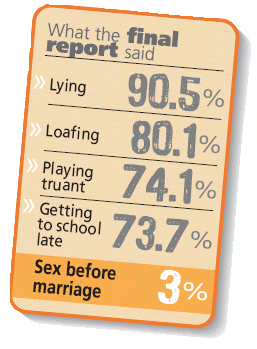
Image hosting by PhotobucketRemember that sensational "every female teenager boinks in school" report that caused such a furor. Walski had highlighted this in another post last weekend. It appears now that the report was in error, and that the final result presents a totally different picture.

The Sun today ran a story (on page 8) which stated that the correct figure of repsondents who admitted to having pre-marital sex should have been only 3%, and not the 886 out of 887 as initially reported.

Problem solved, right? Everything hunky-dory, right? WRONG!

To Walski this admission raises more questions. For example, how on earth is it possible to consistently enter the same data field wrongly 886 out of 887 times?

“The consultant team identified the source of the difference as a mistake in entering the right code during data entry from the questionnaire to the Statistical Package for Social Science (SPSS) software,” he said in a statement.
(quoting Inmind [Institut Perkembangan Minda] CEO Norizan Sharif)

Dunno... to Walski that is too much of statistical impossibility to be a data entry "mistake". The virtual screams of "cover-up" could almost be audible to these cynical ears.
(lies, damn lies and statistics, in the full post)

Assuming, however, that it was a genuine mistake, in the first place, the whole study opens up another can of fresh worms, if you were to ask Walski.

But first, chew on this paradox: if the study found that 90.5% of those surveyed exhibited lying tendencies, isn't it very possible that only 9.5% (or 84 of them) answered the survey questions truthfully, and in effect, makes the entire study a sham?

Researcher: Have you ever had pre-marital sex?
Female: Yes
Researcher: Do you lie?
Female: Yes
Researcher: Did you just lie?
Female: No

Incidentally, Institut Perkembangan Minda (Mental Development Institute) or INMIND, is a think-thank organization, operating on behalf of the Selangor state government. This probably explains why Khir Toyo claimed to not know anything about the survey being commissioned, in the Bernama news report where he labelled the report as "rubbish". The survey was initially attributed to the Selangor government directly. Also, as another aside, INMIND's Chief Executive Officer, Norizan Sharif, maintains a blog, Teratak Kembara, under the pseudonym Nobisha (which is probably a concatenation of Norizan bin Sharif).

Looking at the results, it's no surprise that Walski's buddy Howsy quite aptly insinuated that with a high number exhibiting "anti-social" demeanors of lying (90.5%) and playing truant (74.1%), these high-risk femate would probably make good candidates for politicians! And MPs.

But really, what are these female students a high-risk of? Spontaneously combusting? Becoming terrorists? OR, not fitting into the ideal picture of how the Selangor state would prefer its females to behave.

In reality though, the kids behaving the way they allegedly are could be the case where they're merely acting out the angst of teenagehood, compounded with the fact that school for them is a drudgery. Interestingly, nowhere in the news reports does it even venture to explain why these youngsters exhibit such "anti-social" behavior. Apparently it's important enough only to find out what kinds of behavior, and not why.

Neither was there any mention about the intelligence level of these troubled youth - very likely not a focus of this survey either.

Highly intelligent children trapped in an unchallenging environment do tend to act up, in ways that are sometimes construed as being "anti-social".

And isn't being late for school also possibly attributable to the worsening traffic conditions around Selangor? How anti-social of Selangor traffic.

Instead of finding out why behavior such as these have been observed, the purpose (per today's report in The Sun) of the study was "as an additional input for the development of training modules for girls".

Sounds like a morally high-handed venture, wouldn't you think? Who the fuck cares why, as long as they can modularly train the girls to be good, obedient, compliant, future breeding automatons for the great state of Selangor. In which case, who gives a shit what their intelligence level is.

In other words, transforming a whole breed of sociopaths with "undesirable" attributes, into sociopaths with acceptable behavior.

Click here for the full post......