In need to find something?
Custom Search
Related Posts with Thumbnails

Wednesday, March 09, 2011

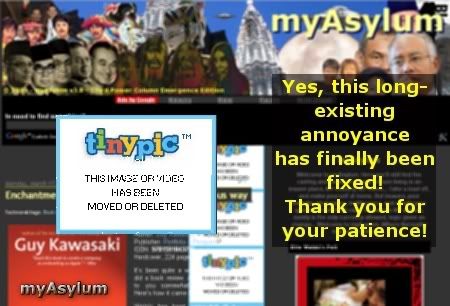
The Tinypic Annoyance: FIXED!

Technorati tags: , , ,

Visitors to this blog may have noticed this annoyance whenever the page starts loading. Heck, you must be blind to NOT notice. Apparently, this has been the case since September 2010, as Walski found out when he finally got down to fixing it last night.

Well, the problem’s been fixed. Finally. And the fix was just a matter of commenting out one stupid line in the blog template script. The root of the problem? A link to the image hosting service, Tinypic.

And that’s the risk of using a highly customized template downloaded from blog template websites, especially if editing HTML scripts isn’t something you’re comfortable with. In fact, Walski had no idea the link was even there to begin with. Until he got down to tracing the problem, and resolving it once and for all.

So, sorry for the possible irritation this might have caused, but the problem is now history… 
(root of the problem, if you’re interested, and more, in the full post)

Since Walski had some time last night, he decided to trace the problem, which he began noticing some months back, but didn’t really bother to do anything about, since the Tinypic error banner does go away once the page loads completely. However, he did notice that page loads were taking ages, but thought that it was either a slow Internet connection or something else in the template causing the delay.

Then, Antares left a comment asking what the heck was going on (in not so many words), and that the Tinypic thing was obstructing his view to the post text. This was about a couple of months ago, at the height of Walski being busy, so nothing was done about it.

And then Masterwordsmith called Walski a couple of weeks ago to “alert” him to the problem. Still, Walski procrastinated. Until last night.

Apparently, sometime last September, Tinypic decided to not accept non-US image uploads anymore (via BloggerzBible). And what probably happened is that the image to which a link was present in the template script was no longer accessible (probably deleted). Which then gave rise to the image not being found, hence the annoying display.

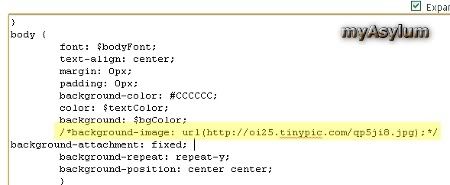
Finding the exact problem, once Walski knew the cause, was real easy – just a matter of doing a text-search for “tinypic” within the template script. The root of the problem? One line in the script that calls up the supposed background image:

All Walski had to do was comment out that line – problem solved! Bonus: the page seems like it loads faster now.

The moral of the story: small things can create big problems, or at the very least, major annoyances….

So, thanks for bearing with the Tinypic annoyance for the last 6 months. Incidentally, if you do find something amiss with the blog, all it takes is to leave a comment, and Walski will get it fixed. Eventually….

Click here for the full post......

Monday, March 07, 2011

Enchantment: Creating Buy-In the magnanimous way

Technorati tags: , ,

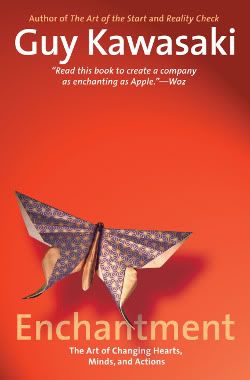
Enchantment by Guy Kawasaki, image hosting by Photobucket Enchantment 
Author: Guy Kawasaki
Publisher: Portfolio – Penguin (US)
ISBN: 9781591843795
Hardcover, 224 pages

It’s been quite a while since Walski last did a book review. And this review comes to you somewhat by happen-chance. Here’s how it came to be:

Walski has been somewhat of a Guy Kawasaki fan, ever since he read “Selling The Dream” many years ago. That, of course, wasn’t Guy’s first book. Although the former Apple evangelist had written two other books prior, Walski must admit that although he’d heard of the name Guy Kawasaki before, he didn’t really know who the person was.

All that changed when Walski read Selling the Dream.

Over the years, he’s read several of Guy’s other books (Enchantment is his 10th). More recently, Walski has also been following Guy on Twitter (@GuyKawasaki), and so when he received an e-mail enquiring whether or not Walski would be interested in reviewing Guy’s upcoming book, he almost automatically responded Yes. At the back of his mind, though, Walski didn’t think that he’d actually get a preview copy for review, being that pre-sales preview copies are usually limited to the US (from experience).

Well surprise, surprise… the book was delivered a couple of weeks ago, and the bargain was struck – Walski was to read the book, and do a review before the official store release of Enchantment, which in the US is March 8, 2011 (tomorrow).

But enough about how this review came to be... the more important question: what is Enchantment all about? 
(Enchantment, how to achieve it, and more, in the full post)

If Walski were asked to provide a one-sentence description, you would have already read it much earlier in this post. Didn’t catch it? Scroll up, and look at the post title. In a nutshell, that’s what Enchantment is about – a book detailing the kinder, gentler way of creating buy-in.

And it doesn’t really matter what you’re trying to sell or promote – it could literally be anything: a product, a service, a community program, a pet cause… Anything, in other words, that would require buy-in to further its success.

Walski’s not sure in what section you would find Enchantment in Malaysian bookstores once it’s available here, but very likely it would be placed in the Business section, under the Marketing category. But the tools you will acquaint yourself with in Enchantment aren’t limited to the business world alone. And that’s one of the key reasons why Walski thinks this book is important one to read.

One of the reasons why Walski likes Guy Kawasaki – as an author – is that his writing style makes reading  his books quite effortless. It’s almost like you open the book, and Guy’s right there talking you through the pages. This personal touch also helps the reader absorb the material more easily.

As with his previous books, what Guy relates to us is, in most cases, not something we don’t already know – which brings us to another reason why Walski likes this book (and his previous others): Enchantment essentially acts as a mental-recall gel, helping you organize what your common sense and inner self probably already know.

Peppered liberally throughout the book are real-life examples and anecdotes relating topically to the components that make up Enchantment. This further helps us understand how the concepts articulated in the book relate to real life situations. And when we are able to relate, we’re more equipped to apply.

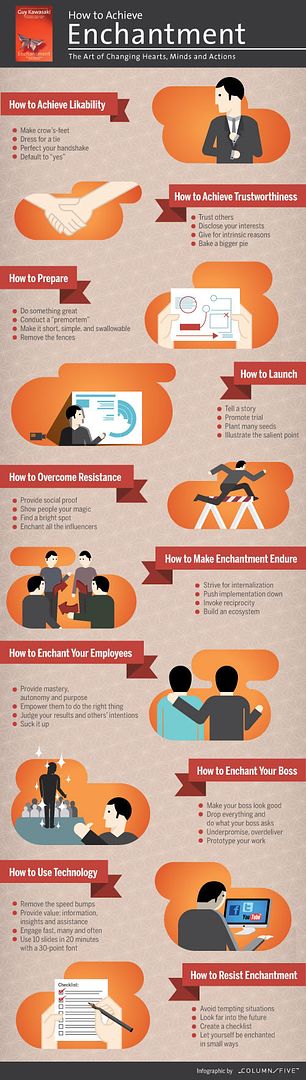
In promoting this book, Guy has provided a plethora of online resources. One of the more enchanting ones is a summary of how Enchantment can be achieved.

Enchantment Infographic, image hosting by Photobucket

Yes, it’s an Enchantment cheat sheet. But as we know, cheat sheets are only useful if you’re familiar with the material they represent. In other words, you get most out of it only if you’ve read the book. Specifically, this cheat sheet does two things:

  • it saves Walski from writing more than he needs to
  • makes you want to learn more (hopefully)

While Enchantment is very possible (and not difficult) to achieve, it may not be appropriate for everyone, or every situation. Guy is honest enough to provide examples of such personalities and situations in his book. As a bonus, he’s even provided an online Enchantment self-assessment you can try out to see how well prepared you already are to begin your journey towards being enchanting.

Walski’s verdict? If you are someone who needs to prepare his/her-self well in order that s/he can more easily and convincingly create buy-in (of some variety), then definitely go buy the book, once it’s available. In the US, the book should be on the shelves tomorrow (March 8, 2011), and probably in a few weeks time elsewhere.

And if you’re not someone who needs to create buy-in at this juncture of space-time, get it anyway. Purchasing a book, particularly a good one like Enchantment, is never a waste. After all, life is but a journey, and you never really know where it will take you, until you get there.

You never know – there may yet be a time when Enchantment is exactly what you’ll need. And a head-start never hurts.

Click here for the full post......

Tuesday, March 01, 2011

The CIJ FoE 2010 Report - Dark days past, darker days ahead?

Technorati tags: , , ,

To say that in Malaysia, one is not allowed to freely express one’s self would be inaccurate. To say that there is true Freedom of Expression in this country would be equally off the mark.

What we do have is a tightly controlled environment, where expressing one’s self is like playing the lottery – in most cases you’d get away with saying what you feel like, but you run the risk of getting yourself into some very hot soup. Not very tasty hot soup, either.

Last Saturday, the 2010 Freedom of Expression in Malaysia report, by the Center for Independent Journalism (CIJ) was featured on BFM 89.9’s Incident Room segment of their Week In Review program. On air to talk to host Richard Bradbury were the center’s Executive Officer Masjaliza Hamzah, and Project Coordinator/Media Monitor Ding Jo-Ann.

You can listen to the podcast by clicking the ‘Play’ button above. While 2010 wasn’t much different from 2009 in terms of restrictions on freedom of expression, what is of immediate concern is the recently announced Online Media Guidelines (via The Star), and its impact on freedom of expression in Malaysia.

Could it be that the introduction of these guidelines is an attempt by the Malaysian Government to control what they currently are unable to?  
(the full CIJ FoE report, and more, in the full post)

What Walski wonders is how exactly is the Government going to monitor every single blog, Facebook and Tweeter account? As we have seen in the print world, certain media bodies owned by components of the ruling BN coalition – either directly or by proxy – are allowed to spew all kinds of inflammatory rhetoric, getting away without even a slap on the wrist.

Will we see a situation where blogs, tweeterers, Facebook pages, and what not, friendly to BN get away scot free with publishing online whatever nonsense they wish to, while those critical of the BN and the government get hunted down? Will one need a license to blog? Or worse, tweet?

This is a situation we’re already seeing in the highly regulated print media world. Is the same going to be the case with online media?

It is not certain when the guidelines will actually be tabled in Cabinet, nor has an implementation timeline been announced. Not much has been reported about it since its initial announcement in early February this year either. So, there’s really no point in further deliberating over something we don’t know the shape, form, or smell of, is there?

But back to the report that Walski mentioned earlier, released last week by the CIJ. While he hasn’t had the chance to read through it cover to cover yet, based on reports from previous years, Walski reckons that it will outline what types of expressions have been tolerated, and what varieties have been suppressed.

He’s taken the liberty of posting the report below, in its entirety, for your reading pleasure.

You can download a PDF copy of the report, either via the Scribd link above, or directly from the CIJ site. It’s the same report either way, so whichever method suits you better makes no difference.

With the next General Elections looming in the not very distant horizon, it is actually rather expected that BN would prefer for it to be heard online, and no one else. As mentioned during the podcast, BN blames the Internet (and the various media within) in part for their dismal performance in GE12.

Since then, though, more BN personalities have been using blogs, Twitter and Facebook to try and make themselves more accessible to the online demographic. Which is a good thing, Walski must add. What’s not so good is the desire to suppress the views of those who don’t view BN as having exclusive rights to govern.

As it is, Malaysia’s RSF Press Freedom Index ranking has been on the steady decline in the past 5 years. While it could be argued that the number of countries looked at year on year generally increases, our ranking relative to the total number of countries considered has dropped in tandem with the number ranking. Our ranking in RSF’s 2010 report placed us at position 141 (out of 178 countries), putting us at about the 79-percentile level.
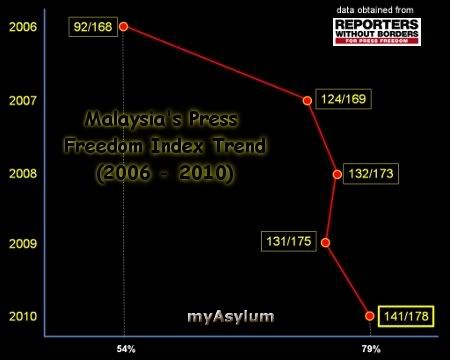
Malaysia's RSF Index Trend 2006-2010, image hosting by Photobucket

Which translates to the fact that Malaysia’s press is freer compared to only 37 other countries. In contrast, Indonesia has been hovering between positions 100 and 111 within the same period. Even Singapore’s press was rated more free in the 2010 report (ranked at 136), something pretty much unheard of in Walski’s recent memory.

While some may say that the RSF report paints a biased picture, their methods of tabulation are clearly defined, if one bothers to read their reports in toto. One measure of a progressive and developed nation is how free its press is. Some may point to Singapore as an example of a developed nation with a muzzled press, but in the bigger scheme of things, our neighbor to the South  is arguably an anomaly. More importantly though, is what Singapore has done over the years to advance itself, through meticulous planning and proper execution.

In an environment where public sector financial leakages have almost become a culture, a free press goes a long way towards correcting this economically debilitating wrong. But instead, the trend seems to be towards cultivating a compliant press.

Adding to that, perhaps with the online guidelines media guidelines, cultivating a compliant citizenry as well. And you wonder why Malaysians continue to seek greener pastures elsewhere?

It is very easy to label organizations like CIJ as “tools of the Opposition”, as some have. Such epithets have been hurled at many other organizations that seek to right the many wrongs that have become entrenched as the status quo. Name-calling and labeling may provide some sort of egoistic satisfaction amongst sycophants, but it does nothing towards solving real problems.

And if real problems continue to be swept under the carpet, we can kiss any aspirations of greatness within our own lifetime goodbye.

A free press, both mainstream and alternative, helps to ensure that said carpet doesn’t get bulgy and misshapen, and eventually ruin the carpet if sufficient crap gets shoved under it.

Curtailing freedom of expression may facilitate short term control. But when that control is premised upon a system that refuses to realize it is in need of repair, further suppression of freedoms may just lead that system to total self-destruction.

Introspection is not exactly a strong trait of sycophants, from Walski’s observation, and if only the voices of sycophants are allowed to be heard, who’s gonna tell you about that badly misshapen carpet, about to burst at the seams?

Click here for the full post......