In need to find something?
Custom Search
Related Posts with Thumbnails

Thursday, October 15, 2009

Princesses Irrelevant of the Talibunnies

Technorati tags: , , ,

Once again, the circus we fondly call the UMNO General Assembly is in town. In one of the rings, we have Puteri UMNO – the junior women’s wing of the party, created (at the same time as their equally irrelevant male counterparts, the Putera wing) so that the younger members can be tricked into feeling some sort of faux relevance in that party.

Okay, you might be thinking that Walski’s being unduly harsh. But if that’s the case, how do you account for this madness?

With so many more serious problems plaguing the nation, this is the nonsense that they come up with?

It’s bad enough that PAS Youth wants to ban everything – these Talibunnies seem to wanna do as much damage. Or more, if possible. 
(vicious bunnies, and more, in the full post)

Now, a Facebook acquaintance, commenting on PU’s statement said: “Next they will be banning fantasy, horror and Sci Fi books, then all films, TV show and all books - hello Taliban”.

To which, Walski said that under the circumstances the term Talibunnies would probably be more appropriate. Said acquaintance then retorted: “Talibunnies I think is too tame a term, too nice and furry, cuddly. These are viscous mutilators of culture and the arts, hence my term talibanistic”.

Walski then reminded his acquaintnace of this viciously furry, cuddle-deadly classic film scene:

So yeah, Walski will stick to Talibunnies, thank you very much. Their deadly venomous true demeanor is elegantly masked by their demure and irrelevant facade. PU indeed…

But demand by Princesses Irrelevant, if taken seriously, does have far-reaching and damaging ramifications, as pointed out by Mariam Mokhtar, via The Malaysian Insider.

Movies today, books tomorrow… sooner or later, even intelligence might be made a crime against the state, if these wannabe Taliban and Talibunnies have their way.

Truth be told, Walski does see behind the political charade, that what PU is trying to do is play one-up-womenship with PAS Youth – the “if they can insist on banning stuff, so can we” juvenile mindset at play.

Which is exactly why these princesses will remain in the Irrelevant bin of UMNO. But don’t tell Puteri UMNO that… otherwise another tear-fest will probably erupt (via NST).

Speaking of being irrelevant – both Khairy Jamaluddin’s (UMNO Youth Chief) and Najib’s speeches spoke of the need for UMNO to be more inclusive of “others”. Oh, and that the benefits of the NEP shouldn’t only be enjoyed by the Malays. Oh, oh… and that UMNO is not racist (snicker) [links via The Edge and The Star, respectively].

If that’s the case, then what the hell is the point of race-based politics anymore, Walski wonders… other than being a playground for irrelevant Talibunny princesses, that is.

Reblog this post [with Zemanta]

Click here for the full post......

Sunday, October 11, 2009

The Legion of Silencers: Fervent Enablers of 1Apartheid

Technorati tags: , , , ,

Call this a rant, if you must. Provocative post ahead? Walski certainly hopes so.

"Silencing The Feminine Energies" by Walt Pourier, via Photo.net, hosting by Photobucket There is a prevailing school of thought that the more harsh and repressive society is, the more “Islamic” in character it becomes. This school of thought sees civil liberties as destructive “Western” precepts that must be curtailed. One of these civil liberties happens to be freedom of thought – ok for the proponents to practice, but not ok when these thoughts run contrary to their set of beliefs and aspirations.

Without further beating around the bush, this post refers to the loose grouping of Muslim NGOs in Malaysia. Their numbers are many, and Walski won’t bother listing each and every one – but this legion of NGOs comes under an umbrella coalition, which calls themselves PEMBELA (or ‘protector’ in English).

Their latest endeavor, as has been reported by both the mainstream and non-mainstream news media, is to silence any dissent against the Pahang State Syariah Court decision on the corporal punishment to be meted out against one Kartika Sari Dewi Shukarno, for the offence of consuming beer.

We won’t go on a tangent to discuss the merits (or otherwise) of the decision, nor of the Joint Action Group (JAG) for Gender Equality’s grounds for protesting. What Walski wants to highlight here is the efforts of this Legion of Silencers to curtail relevant criticisms of concerned persons.

For them, criticism is tantamount to insult – a convenient untruth for those unable and unwilling to engage in intelligent discourse, resorting instead to threats and legal recourse, so as to silence any dissenting voices. 
(selective justice is no justice at all, and more, in the full post)

Last week, Utusan Malaysia, the nation’s leading brain-dead Malay language daily, published a series of letters and articles condemning JAG and SIS. As is typical, instead of wanting to engage in intelligent dialog, the go-to is always censure. And wanting to invoke the Sedition Act against JAG. In particular, to SIS. Even the pseudonymous Awang Selamat put in his two bits – in English – grammatical errors and all.

The effort to request the government to repeal the Syariah Criminal Law enforced in the country with each State has its own set of enactments, is beyond the expectation of many. It is a regression. What more, such call was made by NGOs with Islamic tag.

As organizations which operate in the name of Islam, what is expected by Muslims is the struggle to strengthen the implementation of the law in the country.

Awang feels that it is unbecoming of any attempt to question the syariah law which is well-received by Muslims, who formed the majority of the population in the country.

Infact, even in the case of penalty by canning of Kartika, there is no argument about it since she herself accepts the punishment with full remorse and never once questioned it.

Whatever it is, the authorities should respond to the case of calling the government to rescind the law, with firmness and priority.

Awang feels that it should be handled with tact as it involved so many parties including the sovereignty of the law and Malaysia’s position as an Islamic country.

Awang—feeling disturbed

(source: Utusan Malaysia - October 6, 2009)

But Walski agrees – Awang is indeed a disturbed individual. Or individual by committee, as is the case, in all likelihood. Furthermore, his editorial represents how shallow the Malay-language medium sees the issue. And when confronted with an issue with serious ramifications, the shallow-minded can only respond in one manner – not articulate the issues involved, but invoke retribution of the law.

The latest to join the fray is ABIM – the Muslim Youth Movement of Malaysia. These jokers filed 11 police reports against JAG, as reported by Malaysiakini. Their grievance – that the JAG memorandum “insults Islam”, “threatens the sovereignty of the sultans as heads of the Islamic religion”, and “insults the status of the syariah courts”.

And the memorandum that these Silencers are so adamantly insulted by? You can read it in its entirety here (via the Women’s Aid Organization (WAO) website), but Walski thinks that it is important enough to duplicate the memorandum here, in its entirety.

JUSTICE FOR KARTIKA
The Joint Action Group for Gender Equality (JAG) appeals to YAB Dato' Sri Mohd Najib bin Tun Abdul Razak to take immediate steps to address the issue of the sentence of whipping meted out to Kartika Sari Dewi Shukarno.

JAG also urges the government to review whipping as a form of punishment as it violates international human rights principles which regard whipping and other forms of corporal punishment as cruel, inhuman and degrading treatment. Moreover, research has shown that whipping is not an effective deterrent, even to violent or sexual crimes.

The court’s decision to whip Kartika for consuming alcohol has led to a public outcry at the national and international levels, damaging Malaysia’s reputation as a moderate Muslim country. It also fuels the widespread belief that Islam is a religion that discriminates against women. While civil law in Malaysia prohibits the caning of women, syariah law makes no such exception.

JAG believes there are compelling reasons why Kartika’s case should be reviewed - on syariah, constitutional and legal grounds, international human rights principles, and based on sentencing guidelines. They include:

Syariah Grounds
(i) Qr’anic teachings emphasise repentance, forgiveness and personal transformation. Even the verses on punishment for theft (Surah Al-Maai’dah 5:38-39) and robbery (5:33-34), emphasise that an offender who repents after his crime and amends his conduct, is redeemed, as God is forgiving and merciful.

(ii) Kartika has repeatedly expressed remorse and repented for her action. She should be forgiven, instead of be given the maximum punishment.

(iii) There is no consensus in Malaysia on the range of crimes for which whipping is prescribed,. Only Pahang, Perlis and Kelantan provide whipping for alcohol consumption under their Syariah Criminal Offences Codes.


Sentencing Guidelines
(iv) Under normal sentencing guidelines, Kartika should not have been given the maximum punishment as she had pleaded guilty, was a first time offender and has shown and continues to show remorse.

(v) The whipping sentence is also disproportionate to the gravity of the offence committed, especially since there was no violence involved in the commission of the offence.

(vi) When an accused pleads guilty, it is a mitigating factor. Therefore, the judge should have taken that into consideration in favour of the accused, and should not have meted out the maximum sentences in terms of the fine imposed and number of strokes for whipping.


Constitutional and Legal issues
(vii) Can the Kajang prison which is established under Federal law execute an order issued by the syariah court which is under state jurisdiction?

(viii) Can a Federal authority execute a sentence of whipping against a Muslim woman when the Prison Regulations 2000 forbids corporal punishment to be applied to a female prisoner (of any age), or a male prisoner who is more than 50-years-old?

(ix) Can the Pahang Syariah Court simply impose an additional sentence of imprisonment for seven days after the trial had ended and the case deemed closed, just for the punishment of whipping to be carried out?

(x) The victimisation of Kartika violates constitutional guarantees of equality and non-discrimination under Article 8(2) of the Federal Constitution. Under federal law, a woman cannot be whipped, but under syariah, she can. Daily, thousands of Muslims violate the syariah law which forbids alcohol consumption. And yet, Kartika is victimised with the maximum punishment to set an example to others.

(xi) Is it the duty of the state – in order to bring about a moral society – to turn all “sins” into “crimes against the state”? Or should this be private morality best left to the religious conscience of the individual, rather than be deemed public morality and turned into a matter of law? As practice shows, the enforcement of such moral policing laws has often led to controversies, abuses and public outcry. In the end the Federal Government intervenes and those arrested are released.


International Obligations
(xii) As a signatory to the United Nations Convention on the Elimination of All Forms of Discrimination Against Women (CEDAW) since 1995, Malaysia is committed to uphold respect and equality for women. This commitment is complimented by Malaysia’s obligations under the Universal Periodic Review whereby Malaysia’s delegation had during the UPR process in February 2009 reaffirmed Malaysia’s “respect for human rights long established given the country’s character as a melting pot of various cultures, religions and ethnicities”.

(xiii) Malaysia is also committed to the 1988 ASEAN Declaration on the Advancement of Women, the 2004 ASEAN Declaration on the Elimination of Violence against Women and the 2005 Putrajaya Declaration and Programme of Action on the Advancement of Women in Member Countries of the Non-Aligned Movement.

In the long term, we urge the Government to conduct a comprehensive review of the Syariah Criminal Offences laws of this country, with a view to repeal such laws, thus enabling all Malaysians to be governed by a single Penal Code under federal administration.

In 2005, Sisters in Islam , a member of JAG submitted a memorandum to the Government to reiterate its call for the Syariah Criminal Offences laws to be repealed on the grounds that they have no basis in Islamic legal theory and practice; they conflict with the Federal Constitution and that they conflict or overlap with the Penal Code and other federal laws. SIS had commissioned two reviews by Professor Muhammad Hashim Kamali and Professor Shad Saleem Faruqi and these have been shared with the Government.

The Government must show the political will and courage to once and for all deal with the implications of such intrusive moral policing laws. The implementation of these laws continues to raise numerous profound and controversial issues at the Islamic, constitutional, and human rights levels. They also fail to reflect the changing realities of Malaysian life today. The continual public outrage over moral policing laws reflects the disconnect between state control of private lives and personal choices, and how Malaysians view their entitlements to these rights. This can no longer remain unresolved.
(source: WAO Website)

Now, how on earth can this be construed to be an insult to Islam, a threat to the Sultans’ sovereignty, or even the status of the Syariah courts? If there is a misapplication of law, isn’t that grounds for critique, regardless of which system of law?

Furthermore, why pinpoint action on JAG, WAO and SIS, when other notable persons have spoken out against the issue of whipping Kartika? Is it misogyny, and the prevailing opinion that in “Islam” (as these Silencers understand), women should not be vocal and speak out when there is a perceived injustice?

Walski highlighted the name Muhammad Hashim Kamali in the JAG memorandum for a reason. On September 1, 2009 this renowned authority on syariah law wrote an article for the NST (downloadable in PDF from here). In the article, the professor raises the possibility that the Pahang Syariah Court’s decision to mete out the maximum punishment may be a miscarriage of justice. He even argues that the “crime” of consuming alcohol may not be a “hadd” offence.

And yet, in the case of Kartika, the judge chose to sentence the lady to the maximum allowable by law. For a first offence that Kartika herself had admitted to and shown remorse. Is this the kind of justice that the Silencers want? And because there is no such thing as case precedence in syariah law, the very same overzealousness could be applied by a different judge in the future.

Now, why isn’t anyone going for the professor’s jugular, like they are against JAG, WAO or SIS? Isn’t pointing out that there are flaws in the system, that many see as God’s perfect justice on Planet Malaysia, equally an insult to their sensitivities?

Walski will tell you the reason – selective persecution, that’s why. And guess who’s being persecuted in this case – women organizations. Convenient targets for the intellectually challenged, vocal bigots who cannot see beyond their own jaundiced world view and prejudice.

The frenzy and zealousness of the Silencers does indicate one thing that is indeed disturbing – that what they want for this country is an Apartheid – one set of laws specifically for Muslims – that NOBODY can challenge – and one set of laws for everyone else.

The sad truth is that Malaysia is on a steady path to becoming a failed state – mark Walski’s words. It’s no longer a question of “if”, but of “when”. All the volatile ingredients are there, and how the ingredients have been converging is indeed scary.

Amendments to Article 121 of the Federal Constitution back in the 1980’s, the unwillingness of the civil court system to even touch on any matter deemed to concern Islam, the increasingly vociferous Syariah law fraternity in response to any criticism, aided by their leadership of  the legion of “Muslim” NGOs, the declaration (for political reasons) by the UMNO/BN led government that Malaysia is already an Islamic state, the various political quarters riding on the agenda of insisting that Malaysia become much more an Islamic state than it already supposedly is, the continued and increasing back-door incursion of so-called “Islamic” laws and norms into our personal lives (and not being given the choice nor opportunity to protest), collusion of law enforcement in matters religious, the carte blanche given to the Islamic agencies and bureaucracies to act as they please, the blatant scare-mongering by certain prominent members of the “Islamic” clergy class, the increasingly vocal censure of ordinary citizens in voicing their concerns, the absence of a government with enough backbone to do anything about the subtle slide towards tyranny…. these are just some of the ingredients that Walski speaks of.

All these sometimes independent-appearing pieces of a bigger puzzle have been coming together over the past few decades, hiding in plain sight for all and sundry to see. And the bigger picture the pieces of the puzzle reveal as the convergence continues is not a rosy one.

The proponents of “more Islam” seem to want a more conservative society, where personal space can easily be intruded upon, where one no longer has the liberty to think for oneself without fear of offending “the state”. Where Morality Police roam with reckless abandon, ensuring that life for anyone labeled “Muslim” on their MyKad is lived within the narrow parameters of what their self-appointed moral guardian masters allow.

There will come a time when even expressing concern, and voicing differing and dissenting views about any matter deemed “Islamic” will be considered crimes against the state. We are starting to see the beginnings of it now, as evidenced by the calls of the Silencers, be they subtle in some cases, or blatantly in others. We saw it before with Article 11, and we are seeing it again now.

And the dumbest thing is that what Walski describes is nothing new – we’ve seen it before in many other nations. Iran, Sudan, Saudi Arabia… What boggles the mind is that despite living proof that a state governed with religion as the basis of policy (any religion) eventually becomes a tyrannical one, that is exactly what the Silencers dream of as their ideal.

Once again, mark Walski’s words – we are fast coming to a point of no return. 1Apartheid is a reality we might as well get used to, if we choose to remain in this once great nation. And thanks to the Silencers, that reality may come sooner than we can imagine.

May God have mercy upon us all…

Reblog this post [with Zemanta]

Click here for the full post......

Saturday, October 10, 2009

The Right To Read

Technorati tags: , , , ,

Image taken from Karin's Book Nook, hosting by Photobucket Ever had a “Black Marker Experience”? That’s what Walski calls the disgust he feels when he thumbs through a magazine (usually) and finds that certain portions of it have been blacked-out using a black indelible-ink marker pen. A really crude method of censorship is what it boils down to.

But censorship, in any other less crude way, in this day and age, is really counterproductive. At best, you’ll end up with a whole load of people really pissed off at the government for being so condescending. The bottom line is, however, censorship doesn’t work.

Malaysia has been actively censoring books, films, and other media, for ages – almost as long as Walski can remember. These days, even the Internet is censored, by blocking (or attempting to) certain sites deemed undesirable. And don’t let them tell you otherwise – censorship of the Internet is being done, albeit not on the scale of what certain other countries do.

When it comes to books, censorship is accomplished by banning certain titles, which the powers that be deem to be “dangerous”. Especially when it comes to religion, and more specifically, Islam. The Quranic Text Division of the Ministry of Home Affairs is the party that decides what we mere-mortal Malaysians can or cannot read.

Curious about what books have been banned in Malaysia recently? Here’s a sampling, based on a database maintained by the Ministry of Home Affairs:

Apart from Islam, books deemed sexual in nature or on the supernatural (particularly those written in the national language, Bahasa Malaysia) are also frequently banned. And to protect what, exactly?

Reading, as far as Walski is concerned, is a right. A fundamental right, in fact. And it’s entirely up to him, not some Malaysian government flunkie, to decide what he wants to, or doesn’t want to, read. One could argue that in this day and age, reading and open access to information, can be seen as a basic human right.

And it is partly upon this premise that Walski would like to draw your attention to an important event taking place at KL’s Central Market – The Right To Read Festival – happening today and tomorrow (October 10 & 11). 
(about the festival, and more, in the full post)

Jointly organized by Sisters In Islam (SIS) and the Center for Independent Journalism (CIJ), the festival aims at promoting creativity and independent thought, through the celebration of freedom of expression and the right to information.

There are a whole list of activities scheduled for the two day event, for folks of all ages. This morning, for example, two children’s programs are ongoing at Central Market, even as this post goes live.

The Right to Read Festival will officially kick off this afternoon at 2pm, in Gallery 2 of the KL Central Market Annex (Gallery 2 is located on the 3rd floor), and will feature Wayang Buku, a performance by local actor director Fahmi Fadzil, and Walski’s friend in the arts, singer songwriter Azmyl Yunor. There’s also supposed to be a special mystery guest – you’ll just have to turn up to find out who, ‘cause Walski sure as heck doesn’t know.

You can get the full details of the 2-day event, either via the event pages at the CIJ or SIS websites.

Now, one can understand the involvement of CIJ in this. But what interest does Sisters In Islam have in the promotion of the fundamental right to read?

Now, it’s no big secret that part of the agenda behind book-banning in this country is to curtail any thoughts or ideas contrary to a conservative view of Islam. Alternative views are often shunned by the Malaysian Islamic bureaucracy (who play a very active role in book-banning).

As you may have noticed in the short listing of banned books above, one of the titles is by Dr. Norani Othman, who is a fellow at UKM’s Institute of Malaysian & International Studies (IKMAS). She also happens to be one of the founding members of SIS.

What’s strange about the banning of her book is that the ban was put into effect in 2008, 3 years after its publication in 2005 (via The Chronicle of Higher Education). SIS, in a press statement issued shortly after the announcement of the ban in August last year, had this to say (emphasis by myAsylum).

The issues raised in the banned book evolved around the lived experiences and realities of Muslim women around the world, the impact of fundamentalist Muslim movements on women's rights, the role of the state in managing the process of Islamisation, and the alternative strategies used by various women's movement in their attempts to build bridges when confronting global politics, growth of religious fundamentalism in modern day society. This book explored and discussed how women's groups, not only for Muslims but people from other faiths, can come together to identify the different areas of their lives, where network, cooperation, and solidarity can be strengthen and built upon as contemporary women stake their claims for their rights, justice and equality, principles that are pivotal in the Quran.

In pursuit of our commitment to open more spaces for intellectual debate and discourses, SIS had specially invited the editor of the book Professor Norani Othman to provide us all with an overview and analysis of the challenges facing us today. Here, we must also stress that the banning of the SIS book is not our first experience - it is our third book. “Fiqh Wanita: Pendangan Ulama Terhadap Wacana Agama dan Gender”, written by KH Husein Muhammad was banned in 2007. Another book which SIS helped to distribute “Qur'an and Women: Rereading the Sacred Text From A Woman's Perspective“ by Amina Wadud (Oxford University Press, New York), was banned in 2008.

Other similar books by esteemed authors, which could enrich the Islamic discourse on Islam were also banned, such as “What Everyone Needs to Know About Islam” by John L Esposito; “The Battle for God: Fundamentalism in Judaism, Christianity and Islam”, and “Muhamad: A Biography of the Prophet”, both by Karen Armstrong; “Women and Islam” by Fatima Mernissi; and many more.

(source: SIS Website)

So, what exactly are we being protected from by the banning of books – a wider world view than the religious establishment would like, perhaps?

Thinking about it, though, the mind of the ignorant is probably easier to control. And that, in Walski’s view, is the real agenda – control. He feels that controlling what we read, vis-à-vis religion, allows only for the officially “approved” religious worldview to be heard and read. Is it just Walski, or does this sound a little fascist?

In any case, The Right To Read Festival will officially kick off in about an hour’s time, and Walski hopes that you can spare some time to pay a visit and support this important event.

Important, because reading is a means of overcoming ignorance. And overcoming ignorance is one of the things that can really set you free.

Reblog this post [with Zemanta]

Click here for the full post......

Saturday, October 03, 2009

If you have problems reading this...

Technorati tags: , , ,

… this is probably why.

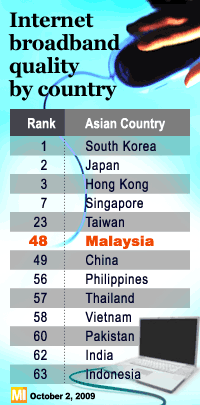
Image grabbed from The Malaysian Insider, hosting by Photobucket Yes, a new study by Oxford University, in collaboration with Cisco, has rated us a not-too-great #48 in terms of broadband quality, as reported by The Malaysian Insider today.

What the report does is officially documenting something Malaysian Internet users are already painfully aware of – that our broadband isn’t all that broad.

Walski urges you to take some time to look at the actual report, which can be viewed here (via the Oxford Said Business School website).

Malaysia’s relatively low ranking, among the countries included in the study, may be telling in itself. But it doesn’t tell the whole story – which, unfortunately, is sadder than simply the ranking.

While the emphasis area that we keep hearing from the government is penetration, i.e. the percentage of households with broadband access, the Broadband Quality isn’t simply about how many people have access to services.

There is, in fact a lot more to Broadband Quality – like data throughput and latency – something that many Internet users in Malaysia can tell you is definitely not up to snuff. 
(factors in the study, and more, in the full post)

The main focus of the study, from what Walski gathers, is how broadband services worldwide are coping with the applications being accessed today, and how future ready they are on the demands of the future.

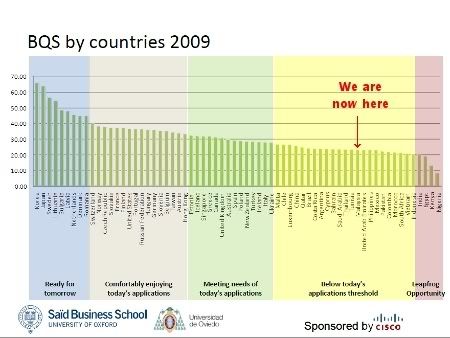
And it is this area that Malaysia fares not very well, ranking in the region of “Below today’s application threshold”.

Chart taken from the Oxford-Cisco study report, hosting by Photobucket

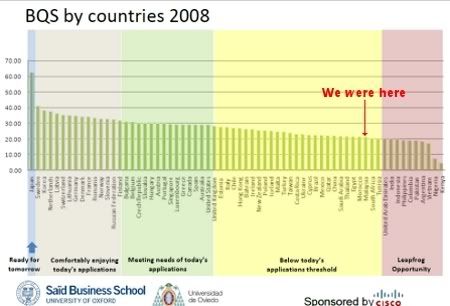
Compared to last year’s inaugural study, we have improved. However, the parameters governing the measurements have also changed, namely the threshold values determining adequacy for now, and for the future.

Taken from the Oxford-Cisco study report, hosted by Photobucket

In essence, the report uses the following main broadband quality parameters (derived from the report, downloadable from here):

  • Download throughput – the net bitrate of downstream data. This criterion is important for effective streaming of high quality video and sharing of large files (increasingly important in collaborative across the ‘Net endeavors)
  • Upload throughput – the net bitrate of upstream data. This criterion plays an important part in sharing and uploading of image/video, and 2-way high quality video communications
  • Latency – time taken for data packets to travel from source to destination. This criteria is important for real-time applications, such as Voice over IP (VoIP)
  • Other criteria taken into consideration include network oversubscription, data packet loss, jitter (measure of latency variation over time), service continuity, etc.

In other words, the report looks at much more than just penetration. One factor that has been introduced into the 2009 report is the disparity of Broadband Quality Score (BQS) between urban and non-urban areas within a given country. This is one area where Malaysia scores rather low – meaning that there is not much of discernible difference of quality between urban and non-urban areas. Which is still not a good thing, because what it implies is that the quality is pretty low throughout.

Some apologists might view this report, particularly when it comes to Malaysia’s placing, as the West trying to undermine our country’s efforts in IT proliferation. If one were to actually read the report, however, it can easily be ascertained that this is definitely not the case. In fact, 4 out of the top 10 countries on the list are in Asia, with the top 3 being South Korea, Japan and Hong Kong (in order of ranking).

There is also an implicit link between broadband quality and the economic focus of a given country. If Malaysia wants to transition towards becoming a more high-value, technologically driven economy, the availability of a world-class communications infrastructure becomes an important factor. Apart, of course, from a world-class education system – another area where much is left to be desired.

The question on the minds of many Malaysians, Walski included is this: how is it that Malaysia has fared so badly despite the fact that the MSC (Multimedia Super Corridor), launched in 1986, was supposed to propel Malaysia prominently into the world of IT? 13 years later, we’re still talking about broadband penetration (currently at around 26% or thereabouts) as being the key benchmark, and not about other more important factors, such as quality of service.

Apart from a quantitative analysis, the report also provides some broad recommendations to countries in how improvements can be realized. Some of these recommendations include (emphasis by myAsylum):

  • Set national broadband agenda with goals for availability, penetration and quality.
  • Provide content and applications that are quality-aware to ensure a consistent customer experience
  • Build a broadband business model based on quality as the key differentiator

Any Malaysian broadband user that has used similar services abroad will immediately realize that something is amiss with the level of quality provided within Malaysia. It is, in fact, glaringly obvious sometimes, as Walski has discovered. “Best Effort” is simply no longer good enough a promise that an increasingly globally-aware Malaysian population will put up with.

What he wonders, though, is if the right criteria are being looked at, as we strive for improvement. So far, it seems that penetration, and penetration alone, is the focus, implying that if our target is met (50% by 2010), we’ll still be playing catch-up in other, more critical areas.

Reblog this post [with Zemanta]

Click here for the full post......