In need to find something?
Custom Search
Related Posts with Thumbnails

Saturday, October 09, 2010

Imagine...

Technorati tags: , , ,

Imagine, if he were still alive today, and brought Google up on his browser (yesterday, and likely for the rest of the weekend). This is what he would see.

Google front page screenshot, image hosting by Photobucket

Clicking on the “Play” icon placed where the “e” would normally be, imagine the expression on his face when he sees this played.

But then again, because he was such an enigmatic character, it would really be hard to imagine exactly how he would have felt about the Google and YouTube tributes.
(we too can Imagine, and more, in the full post)

Those of you born after 1980 may or may not know who this tribute is for.

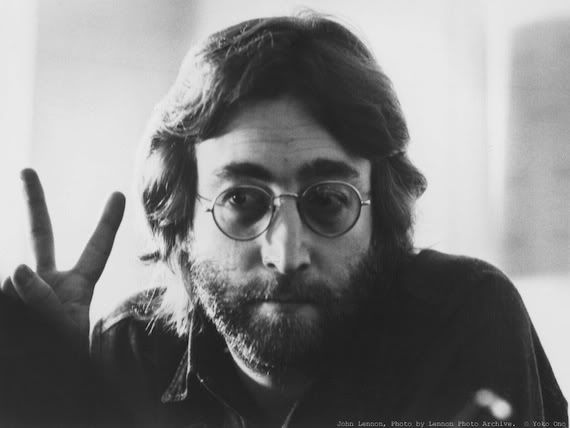
Imagine: John Lennon - soundtrack album cover, taken from Wikipedia, image hosting by Photobucket Had he been alive, John Lennon would have turned 70 today. Being born in the 60’s, The Beatles were very much a part of the popular music landscape when Walski was growing up. Lennon was one of the Fab Four, and arguably the more iconic songwriter of the Lennon/McCartney team, responsible for penning most of The Beatles songs.

Or at least that’s what Walski thinks. Nothing against Paul McCartney, a fantastic songwriter and musician in his own right, but Lennon’s lyrical prowess, coupled with his passion for peace, resonated with many around the same age group as Walski.

Yes, Lennon was an idealist, and in a world becoming increasingly conservative (even then), was also a controversial figure at times. “Give Peace A Chance”, written in 1969 remains today an anthem for anti-war activists the world over.

Walski imagines that if he were still alive, Lennon would be as outspoken today, just as he was back then. And perhaps, within conservative circles, just as hated. 

But John Lennon was a lot of things – songwriter, poet, musician… a true all-around artist. He was also an activist who was anti-war, and very much pro-peace. And Imagine, the song that’s synonymous with Lennon, articulates his dream and hope for a peaceful world.

The world today, though, is the antithesis of Lennon’s dream. And what Walski imagines is that John Lennon, were he to be alive today, would be sad to see what the world has come to. And would probably have more than a few words to say about it, it asked.

Google's Doodle tribute to John Lennon, image hosting by Photobucket

If you read through the lyrics of Imagine, many of the things Lennon imagined his idealized world to be without are the very things that seem to be the root cause of why we fight one another. Namely: sovereignty, religion, and greed.

Sovereignty dichotomizes the world, creating artificial boundaries that divide us. Protecting those boundaries can sometime lead to hate, and to war. Religion, which some people argue would result in a chaotic world if it were non-existent, is in fact a factor why we fight with each other. And greed begets more greed, an endless cycle that sometimes drives people to do unconscionable things to one another, and to mother Earth.

It does make Walski wonder sometimes – would the world be a better place if these three things were non-existent? Would we hate less, and love our fellow human beings more?

Truth be told, Walski doesn’t know the answer. But just as Lennon did, we too can Imagine

John Lennon - Peace - taken from BeatCrave.com, image hosting by PhotobucketJohn Lennon: October 9, 1940 - December 8, 1980
Imagine… Peace… Always…

Click here for the full post......

Wednesday, October 06, 2010

Poll Position: The Good, The Bad and The ETP

Technorati tags: , , ,

Recently, Walski put up a poll via Twitter and posted on the sidebar of this blog. The poll closed a couple of weeks ago, but this is the first opportunity Walski has had to address it. Better late than never, he always says.

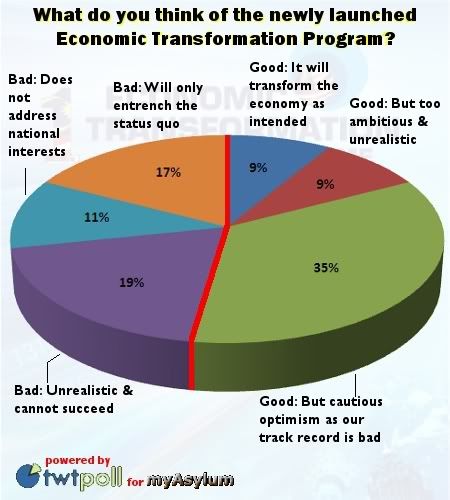
In any case, here are the consolidated results:

Poll Position results, image hosting by Photobucket

Consolidated, because all the Other choices indicated that the ETP will “enrich the cronies only”. Since this, in essence, is similar to “entrenching the status quo”, Walski has decided to lump the results into a single category.

Consolidating the results further, we could also add up the Good and the Bad responses, giving us 53% who think the ETP is Good, and 47% who think it’s Bad. The red line you see in the result graphic above shows this divide.

Mathematics aside, that’s a very good indication that the general public’s feelings about the ETP are mixed. Almost straight down the middle, with a slight upside to it being Good. These days, any upside counts. 
(poll analysis, Walski’s viewpoint, and more,  in the full post)

What Walski found particularly interesting was that 11% thought that the ETP does not address National Interests. He doesn’t have any demographic idea of who selected what, and so he can only make a guess as to which group this represents.

And his guess is that the 11% represents those who are against economic liberalization and transformation, on the grounds such transformation puts racial quotas and entitlements at risk. Walski doesn’t need to elaborate further. Suffice it to say that this is merely a guess, based on the current Malaysian socio-politico-economic atmosphere.

Walski’s personal feel is that the ETP is a good program overall. However, that said, he is part of the 35% who have expressed cautious optimism. But in his case, this is only because our track record of implementing any institutionalized programs in the past have left a lot to be desired.

The ETP, however, is designed to be driven by the private sector, which is a big departure from previous initiatives, which have been public sector driven. Perhaps this is the key ingredient that may make the program a success.

Another reservation that Walski has is the timeline of achieving the lofty goals of this program, which is racing for the transformation to bear fruit by year 2020. His personal opinion is this: this is a good program, but 10 years may not be enough to fix areas that need fixing AND achieve the goals of the program.

In particular, Walski feels that what needs fixing most is our education system. And such changes require time, in addition to a good fixer-upper plan. As it is, the Ministry of Education has hinted that a total overhaul of the education system may be required, although the specifics have not been announced.

That said, there are other workarounds that could be put in place, but some of these involve the attempt at bringing home Malaysian talent currently living and working abroad. The New York Times recently published an article about how this very brain drain is holding Malaysia back.

Although the article focuses on income levels, education, and (to some extent), the NEP, Walski’s personal feel is that there are other factors that make returning to Malaysia a not-so attractive prospect. One of those factors, he thinks, is civil liberties, something that he feels has deteriorated significantly.

Walski’s not just talking about freedom of speech and freedom of expression, but the freedom to live one’s life the way one sees fit. The increased policing of personal freedoms is one thing that the government needs to address if it wants to make its Talent Corporation initiative a success (via The Star).

What we need, he thinks, is something he calls Re-Liberalization of Society. Walski will elaborate more on this concept in a separate post.

The bottom line is this – the Economic Transformation Program is not something that can succeed in a vacuum. It is reliant on a lot of other things to transform in tandem, one of them being a successful GTP – Government Transformation Program – that is also being spearheaded by Pemandu almost in parallel.

Most of all, it takes a government that has the maturity and political will to see these programs through. And herein lies Walski’s biggest worry. Its performance in this department has so far not been encouraging.

At the end of the day, what Walski thinks we all want, as Malaysians, is for the country to progress and be a better place not just for ourselves, but for our future generation. If it takes an alphabet soup of initiatives to get us there, then that’s what must be done.

As the saying goes, “where there’s a will, there’s a way”. But the question that lingers in Walski’s mind is whether that crucial will is already there or not.

No idea or initiative will be without it’s critics and detractors. From a political standpoint, however, if an initiative is for the greater good of the nation, the political opposition should be critical, but not criticize simply for the sake of criticism. Neither is any initiative or program flawless, and therefore requires criticism. But this criticism needs to be constructive in nature.

For Walski, he thinks that the ETP is a good move in the right direction and he’s optimistic. But that optimism is a cautious one – the government also needs to prove it has the will to transform.

And so far, in Walski’s book, while there’s apparently a want to transform, the actual transformation is still forthcoming. The time for flowery rhetoric is over – what he needs to see is action, and real results.

The good cannot exist without the bad. That’s a reality of life. But the good needs to supersede the bad. Otherwise, all we’re left with is the ugly. In this case, an ugly alphabet soup that tastes as horrid as it looks.

And that, Walski’s quite confident, is something that nobody wants.

Click here for the full post......

Tuesday, October 05, 2010

It's a Question of Trust

Technorati tags: , , , ,

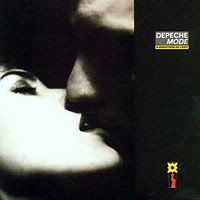
Depeche Mode's "A Question of Lust" single cover image, taken from Wikipedia, hosting by Photobucket Based on his post a couple of weeks ago, you might think that this time around, Walski is writing about music once again. Well, you would be partly right. Which also means that you’d be partly wrong.

But first, let’s get the “partly right” bit out of the way.

The post title is a line from Depeche Mode’s 1986 Black Celebration album. The portion of the song (entitled “A Question of Lust”) that Walski has in mind is this:

It's a question of lust
It's a question of trust
It's a question of not letting
What we've built up
Crumble to dust
It is all of these things and more
That keep us together

(source: Sing365.com)

Ignoring the first line, the rest of the verse (the chorus, in fact) has very much to do with what’s on Walski’s mind. In a nutshell, without a certain level of trust, whatever we’ve built – friendships, relationships, and even nations – can crumble under the pressure of our metaphorical “lust”. It’s a want of the flesh, but not necessarily in ways lascivious or sexual.

So, what brought about these lyrical thoughts?
(the erosion of trust, and more, in the full post)

Essentially it’s the latest furor in cyber-Bolehland – the allegedly racist remarks made by Hamim Husain of the National Civics Bureau (or BIro Tata Negara – BTN). The story broke when a journalist from online news site The Malaysian Insider (TMI) went undercover and reported on a closed-door Puteri UMNO meeting, during which Hamim supposed referred to the Chinese community as “si mata sepet” (slant-eyes), and the Indian community as “si botol” (from kaki botol which means ‘drunkard’).

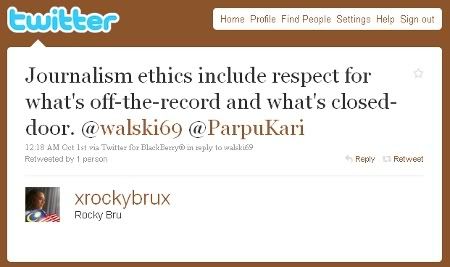
Government and UMNO/BN apologists then raised the question of ethics, and opined that Boo Su-Lyn, the TMI journalist, had acted unethically in going undercover and attending the Puteri UMNO closed-door event. One of those who had such opinions was veteran journalist Ahirudin Attan, more popularly known as Rocky Bru. He and Walski had a short exchange on Twitter, in which, responding to something Walski had tweeted earlier, had this to say:

Twitter conversation with Rocky, image hosting by Photobucket

Walski’s reply to Rocky was this:

Even when it involves a govt rep disseminating hate (allegedly) in an official capacity? That sounds like public interest to me.
(source: Walski's Twitter status)

Now, Walski's not entirely sure why Ms Boo went undercover in the first place. Perhaps it was a tip-off that certain unsavory things would be said. Perhaps it was something else. He doesn’t know, and frankly, that’s entirely beside the point.

Investigative journalism does require a certain level of stealth, which in this instance UMNO/BN apologists say was “unethical”. To Walski, the expose has to do with the greater good and public interest. If Hamim did utter what he allegedly uttered, in his capacity of a civil servant, then it is of public interest to know that the BTN – taxpayer funded, incidentally – is disseminating such rhetoric and speech.

Walski bets you that if the tables were turned, and it was something unsavory being said during an opposition party’s closed door event that a journalist went undercover to and reported, “ethics” would probably be the last thing on these same apologists’ minds.

Rocky also had this to say:

Twitter conversation with Rocky, image hosting by Photobucket

And this became part of the reason why Walski had Depeche Mode thoughts all of a sudden, and wrote this post. The answer to Rocky’s rhetorical question is, of course, “no, we don’t” – provided that it was indeed the speech of “one bad apple”. Or some other variety of fruit.

The key point here is whether this sort of rhetoric is endemic to BTN (because this is certainly NOT the first time something along the same lines has been reported), or whether it’s the opinion of one BTN officer. This is the same reasoning that has prompted the Cabinet to order a probe into the incident (via The Malaysian Insider).

Personally, Walski has experienced first-hand similar kind of rhetoric coming from a BTN officer. This was a long time ago just after Walski finished his SPM. 29 years ago, to be exact. Plus there is the anecdotal history of other BTN officers spouting similar rhetoric.

One isolated incident may be explained by the “bad apple” theory. Two incidences – perhaps a rotten branch bearing fruit. But when similar speech is reported in numerous incidences, perhaps the apple tree itself is diseased. And this raises much concern.

Why? Because, it’s a matter of trust. If indeed this sort of skewed racial reasoning is endemic to BTN, then BTN has no place in a civil multicultural society. More so since BTN is part of the Civil Service, which is there to serve all Malaysians, regardless of creed and color-tone. The sort of speech that has numerous times, allegedly, been spouted by members of the BTN, only goes towards eroding trust among our citizenry.

Sadly, there are some Malaysians who prefer to look at the incident through the narrow confines of their narrow agenda. And to file a police report in the process (a favorite hobby of this bunch).

Walski simply cannot fathom the logic: racist speech is racist speech, whether said in private or not. To think that it’s okay when done in private is simply impossible for him to understand. It does, however, speak volumes about the way Perkasa thinks.

If Perkasa was loathed before, this latest move isn’t going to earn them any new friends from civil Malaysian society. At least not this Malaysian citizen. In Walski’s book what they’re doing is further eroding the trust held by the citizenry that the Malaysian Civil Service be impartial and apolitical.

This erosion of trust, as the song tells us, has the capacity to destroy the unity that we’ve managed to maintain, albeit crumbly at times, over the better part of half a century. The last thing we want to see is for that fragile unity to crumble to dust. If that happens, the nation we hold dear may just be reduced to ashes.

For sure, Walski does not intend to be around if that happens. Dust to dust, ashes to ashes…

That said, Ashes to Ashes is another song, by another artist, and the subject of another post, at another time…

Click here for the full post......